


 Global Central Banks Brace for More Rate Hikes as Inflation Risks Rise
  Moody's Upgrades Argentina's Credit Rating Amid Economic Reforms
  Bitwise Launches NEAR ETF as $562 Bull Case Fuels AI Crypto Buzz
  S&P 500 Relies on Tech for Growth in Q4 2024, Says Barclays
  Aztec Revives zk.money for Private Ethereum Payments
  Urban studies: Doing research when every city is different
  XRP Rises as Evernorth Merger Vote Clears Key Nasdaq Hurdle
  STX.CITY Melts the Charts": Crypto Category Heat Map Shows Bitcoin L2 Mania Leading the Pack
  Robinhood Chain Meme Coins Slide as Stock Token Locks Rise
  China’s Growth Faces Structural Challenges Amid Doubts Over Data
  Michael Saylor Sees Strategy, Strive Expanding Bitcoin Credit Market
  Geopolitical Shocks That Could Reshape Financial Markets in 2025
  Oil Prices Dip Slightly Amid Focus on Russian Sanctions and U.S. Inflation Data
  Bitcoin Slides Toward $83K as Treasury Yields Hit 2007 High


 Add as a preferred source on Google
The Kiwis central bank (RBNZ) left the stance of monetary policy broadly unchanged today, as widely anticipated. The RBNZ’s headline was that a further easing in monetary policy has been delivered. But it is “further” only in the sense that the RBNZ has been explicit about the long timeframe over which it intends to buy bonds under the LSAP. The rate at which it intends to buy bonds has not changed, so we would say that the stance of monetary policy has not changed.
However, the RBNZ has provided useful clarity to markets, both about the future of the LSAP and about its readiness to deploy a negative OCR.
The RBNZ expanded the cap on the Large-Scale Asset Purchase (LSAP) programme from $60bn to $100bn. But that is not necessarily a monetary easing, because the new timeframe over which the purchases will be conducted is much longer. Previously the LSAP programme was $60bn by May 2021, which implied an average weekly purchase pace of around $900m per week. Now the LSAP now $100bn by June 2022, which implies an average purchase pace of only $800m per week. Describing the LSAP as a larger number over a longer timeframe does do two things: 1) it gives the RBNZ more flexibility to frontload purchases if necessary; and 2) it provides more certainty to the market.
NZDUSD price plunges below 0.65 levels as bears are intensified as predicted in our recent posts.
OTC Updates and Hedging Strategies:
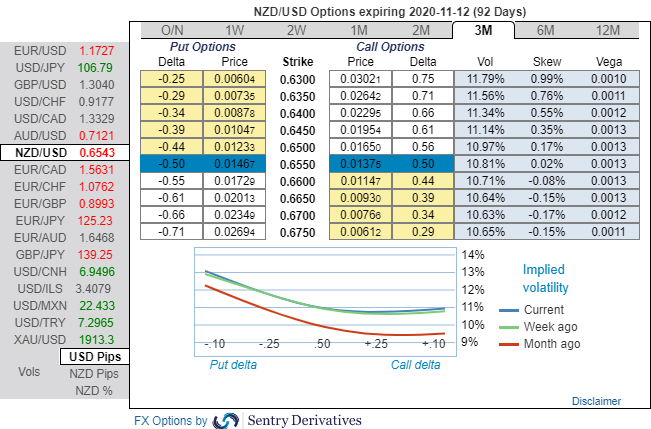
Let’s now quickly glance through OTC updates before deep diving into the strategic frameworks of NZDUSD. The pair is showing higher IVs among G10 FX bloc (3m IVs are in between 10.65 – 11.79%).
IV factor is highly imperative in FX option dynamics because the option pricing significantly depends on future volatility, and it is quite impossible for any veteran to ascertain accurate future volatility.
The skewness of 3m IVs still signals extreme downside risks, bids for OTM put strikes are quite visible (up to 0.63 for these tenors, refer above chart). Based on above-mentioned fundamental factors and OTC outlook, diagonal debit put spreads are advocated on RBNZ’s post monetary policy effects, the strategy is designed to mitigate the downside risks with a reduced cost of trading.
The execution: Short 1m (1.5%) OTM put option with positive theta (position seems good even if the underlying spot goes either sideways or spikes mildly), simultaneously, add long in 2 lots of delta long in 3m (1%) ITM -0.79 delta put options capitalizing on the minor upswings in the short-run.
Alternatively, we recommend short hedges staying shorts in NZDUSD futures contracts of September’20 delivery with a view of arresting bearish risks in the major trend (spot reference: 0.6545 level). Courtesy: Sentry & Westpac







