


 US Plans ‘Toughest Sanctions in History’ on Iran, Bessent Says
  US Treasury Buybacks Ease Global Bond Yield Surge
  RBA Signals More Rate Hikes Possible as Australia Battles Stubborn Inflation
  Japan Trade Deficit Widens as Imports Surge on Energy and AI Demand
  BOJ Expected to Hold Rates Steady While Signaling More Hikes Ahead
  BOJ Minutes Signal More Rate Hikes as Inflation Risks Grow
  Oil Prices Climb as US-Iran Hormuz Tensions Rattle Markets
  Japan Services Producer Prices Rise 3.2% in June, Supporting BOJ Rate Hike Expectations
  Trump Says Iran Talks Halted as Strait of Hormuz Dispute Fuels Oil Concerns
  Chile Central Bank Holds Interest Rate at 4.5% as Inflation and Global Risks Persist
  Gold Holds Near Two-Month High as Treasury Yields Fall


 Add as a preferred source on Google
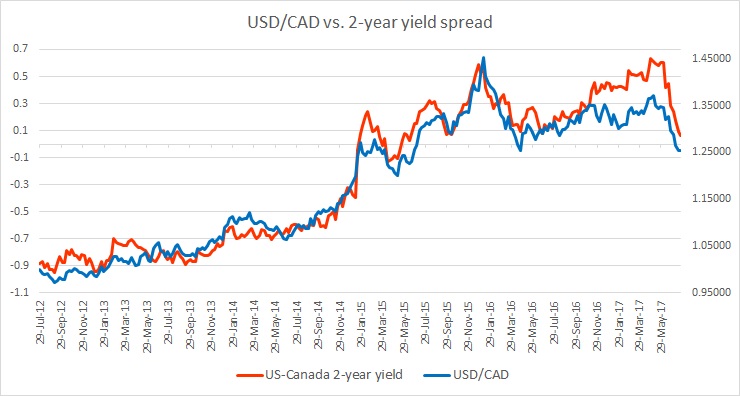
The chart above shows, how the relationship between USD/CAD and 2-year yield divergence has unfolded since 2012.
- The close relations between the short-term yield spread and the exchange rate is quite visible and the relation, in this case, is closest among all commodity pairs.
- Reserve Bank of Canada (BoC) reduced rates from 300 basis points to just 25 basis points after the financial crisis of 2008/09. It somewhat increased interest rates due to a recovery in oil prices and higher inflows of money from other western economies. It raised rates by 75 basis points to 1 percent in 2010. It started reducing rates again beginning January 2015. The rates steadily declined from 1 percent to 0.5 percent by July 2015, when it signaled a halt.
- It can be seen from the chart that the Canadian dollar declined from a parity against the dollar in 2012 to 1.18 per dollar by the end of 2014. The yield spread during the period rose from -88 basis points to -37 basis points in favor of the US dollar. As the spread continues to rise and reached 13 basis points, the Canadian dollar declined to 1.25 per dollar.
- The spread reached a peak around 56 basis points in January 2016 and the Canadian dollar declined to 1.45 per dollar. By April that year, the spread narrowed to 10 basis points and the Canadian dollar declined rose to 1.25 per dollar.
- While April this year, the spread widened again to a new peak of 63 basis points in favor of the USD, the Canadian dollar declined only to 1.37 per dollar.
- After BoC signaled a possible rate hike in June, the spread narrowed from 60 basis points to 7 basis points as of today and the loonie has strengthened from 1.35 per dollar to 1.255 per dollar.
We highly recommend steady monitoring of the spread as it is showing high levels of correlation with the exchange rate.
FxWirePro launches Absolute Return Managed Program. For more details, visit http://www.fxwirepro.com/invest







