


 Pinterest Stock Falls as CFO Julia Brau Donnelly Resigns
  New Zealand Moves to Ban Social Media for Children Under 16
  Salesforce Shares Surge as AI Demand Powers Q2 Earnings Beat
  U.S. Probes Apex Logistics Over Nvidia AI Chip Shipments to China
  BofA Names ASML Top Semiconductor Equipment Pick on Growth, Valuation
  Nvidia Pauses AI Cloud Financing Deals Amid Antitrust Concerns
  Nvidia Options Price in $280 Billion Earnings Swing
  Faraday Future Delivers First Robots in Middle East, Plans September Launches
  SoftBank Eyes $20 Billion Bond Sale to Refinance OpenAI Loan
  Xiaomi Unveils Xring O3 Chip for Flagship Foldable Phone
  U.S. Disrupts China-Linked Hacking Campaign Targeting Government Agencies
  Samsung Shares Tumble 8% as $79 Billion Return Plan Disappoints
  Google Expands Gemini Enterprise With AI Tools for Legal Sector
  Trump Buys SpaceX Shares After Record IPO
  Nvidia Reportedly Eyes $13 Billion Hugging Face Acquisition


 Things - EconoTimes)


 Add as a preferred source on Google

If ever proof were needed that not everything is improved by connecting a device to the Internet, the Juicero, a fruit and vegetable juicing machine, is it. At US $400, the Juicero produces a glass of juice from an US $8 Juicero pack containing pre-mashed fruit and vegetables. It turns out however, that the machine is a completely unecessary part to this process because the juice can be squeezed out of the packs by hand.
The Juicero is connected to the Internet however and this, the CEO has claimed, is what makes the machine essential to the production of juice. Should there be a problem with the packs of juice that are delivered to customers, the machines can be remotely instructed to warn the customer. Of course, this means that the machines are being closely monitored by the company, so people making there juice this way have presumably decided to forego their privacy.
Investors allegedly saw something in this machine that the public is having a hard time understanding. Google’s venture capital arm, amongst others, invested US $120 million in the company.
Juicero represents a perfect example of how technology for technology’s sake has become a marketing strategy aimed at people who identify as being a connected, innovative, and technologically fluent.
The Juicero has highlighted the redundancy of adding technology, Internet connectivity, data analytics and mobile apps to products. But the Juicero joins a long list of products that are as high-tech as they are lacking in utility.
Adding Bluetooth and Internet connectivity to a device, making it part of the Internet of Things has simply not brought about any additional benefits. This has been especially true of home devices that are controlled or interacted with by everyone in the household. Making sure that everyone in a family, or shared living space, has an app, properly configured to communicate with the devices, and are all trained to use it becomes a major IT challenge. It is simply far easier to pick up a remote or walk over to the device and interact with it manually.
The Bluetooth connected Nespresso coffee maker for example allows you to start the coffee brewing process from a mobile app. Only however, once a pod has been loaded, water poured into the reservoir, and the cup placed ready to receive the coffee. The added connectivity simply adds to the cost without significant benefit.
The Internet connected air conditioner suffers the same problem. There are simply very few times when you want to be able to control the temperature of a room that you are not actually in .
A possible justification for enhancing some devices with technology has been their role in potentially helping people manage health and wellbeing and in particular, the ever-growing problem of obesity.
The HAPIfork has been pitched as a technological solution to helping people lose weight by encouraging slower eating. In this case, it is a fork that is not only connected to a mobile app to provide data on eating habits, but also vibrates when people using it are eating too fast.
The only problem is, there is little evidence that eating slowly actually makes any difference to people’s weight. Worse still, a recent study showed that although giving feedback through a fork slowed eating, it made no difference to the total amount of food consumed.
The health and wellbeing justification for technology in products becomes stretched however with its application in other areas.
A Bluetooth connected, mobile app equipped, toothbrush guides and educates its users how to brush their teeth properly.
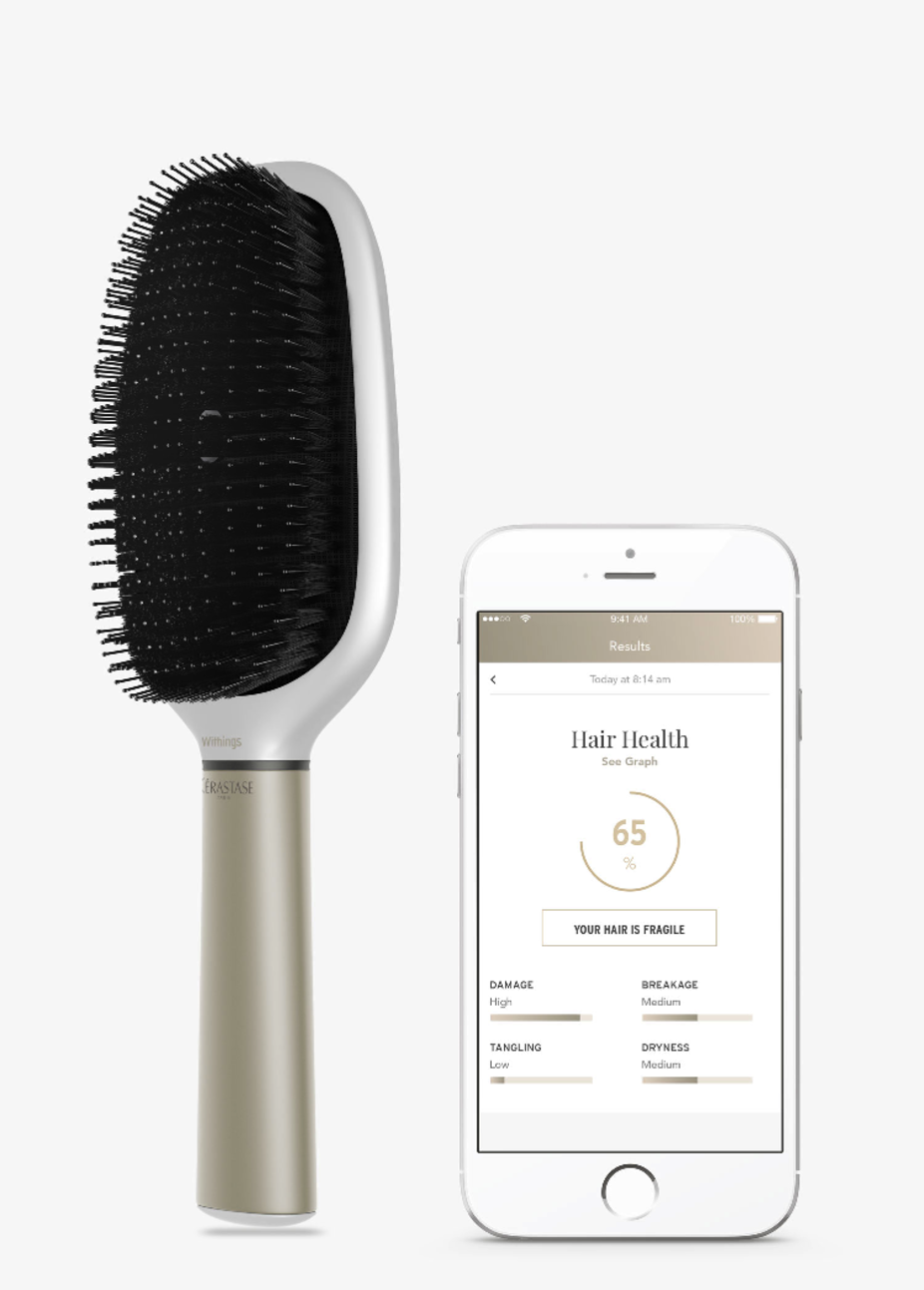
The Withings Hair Coach, a Bluetooth and mobile app-equipped hair brush educates its users in how to brush their hair correctly without causing any damage.
Interestingly, this last device has come from a collaboration between Withings and two cosmetic companies, Kérastase and L’Oréal. For years, cosmetic companies have practised their own type of product enhancement by dressing up products with pseudoscience in order to justify a premium price. The move to use technology in the same way would seem like a natural next step.
Even if these devices did bring the benefits they claim, there would still be the problem that people would not continue to use them for very long. There are simply not the incentives to use the products on a consistent basis for very long.







