


 Gold Prices Fall as Treasury Yields Rise on Fed Rate Hike Bets
  US Stock Futures Fall as Treasury Yields Surge Ahead of Trump-Xi Summit
  Japan Private-Sector Growth Slows as Domestic Demand Weakens
  Oil Prices Extend Losses as U.S.-Iran Talks Ease Supply Fears
  Oil Prices Surge as U.S.-Iran Diplomacy Hopes Fade
  China’s ‘Lipstick King’ Says AI Won’t Replace Livestream Hosts
  Asian Currencies Mixed as Dollar Holds Near Two-Month High


 Add as a preferred source on Google
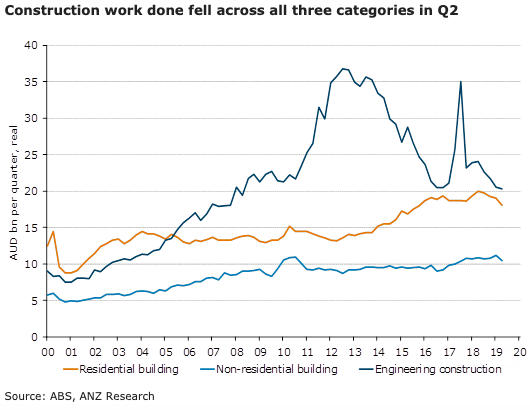
Australia’s construction work done fell for a fourth consecutive quarter in Q2. The contraction in residential activity accelerated, non-residential building activity dropped across both private and public sectors, and the weakness in engineering construction persisted, with only a small uptick in public sector work done, according to the latest report from ANZ Research.
Construction activity in Australia fell 3.8 percent q/q in Q2 2019 to be down 11.1 percent y/y. This was the fourth (and largest) quarterly contraction in a row. The decline in residential construction worsened to -5.1 percent q/q, dragging the annual result down to -9.6 percent. Non-residential building saw an even larger fall of 6.6 percent q/q and engineering construction rounded off the trifecta, down 1.1 percent q/q.
After two quarters of disappointing results, public engineering construction eked out a 0.9 percent gain in Q2. However, it remains 16.1 percent down from the peak a year ago despite the solid pipeline of infrastructure projects. Public non-residential building dropped a further 4.9 percent q/q, following the 2.9 percent fall in Q1.
New building (-5.3 percent) and alterations and additions (-3.3 percent) combined to drag down private residential activity to its lowest level since late 2015. Private engineering construction has not yet bottomed out, falling 2.5 percent q/q, while private non-residential building lost all of the gains from Q1 and then some, down 7.3 percent q/q.
Western Australia (+1.4 percent q/q) was the only state to see a rise in construction, driven by a 2.1 percent q/q increase in engineering construction along with smaller improvements in residential and non-residential building. Queensland (-6.0 percent) recorded the largest decline in construction activity followed by South Australia (-4.8 percent), Victoria (-4.4 percent), Tasmania (-4.1 percent) and New South Wales (-1.9 percent).
"The sharper-than-expected fall in construction activity during the quarter will undermine GDP growth in Q2 2019 and puts downside risk on our pick," the report further commented.







