


 US Treasury Bond Buybacks Fall Short Despite Expanded $6 Billion Cap
  Fed’s Logan Signals 50 Basis Points More in Rate Hikes
  Oil Prices Slide as Middle East Flows Recover
  US Alcohol Ban Exposes Canada’s Internal Trade Barriers
  Asian Stocks Rise as Bond Yields Ease Ahead of U.S. Inflation Data
  Asian Stocks Fall as US Jobs Data and Oil Risks Rattle Markets
  Oil Prices Hold Steady as Middle East Supply Risks Persist
  Tokyo Inflation Jumps to 2.7%, Boosting BOJ Rate Hike Expectations
  Trump Eyes $54 Billion South Korean Investment in Alaska LNG
  US Stocks Slip as Treasury Yields Ease, AI Trade Rebounds
  Best Gold Stocks to Buy Now: AABB, GOLD, GDX


 Add as a preferred source on Google
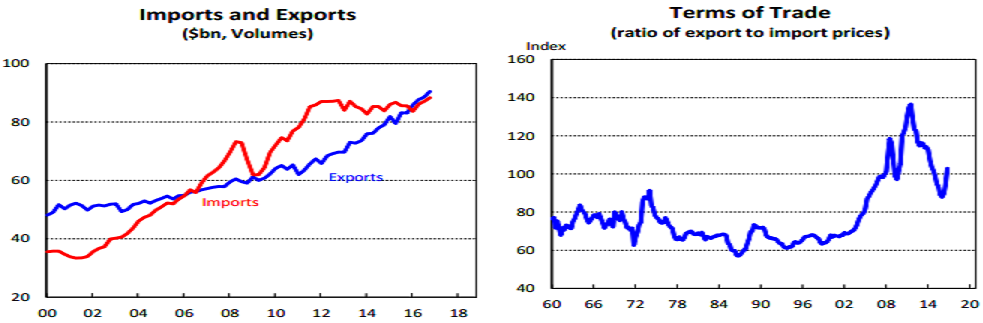
Australia’s current account deficit narrowed significantly, from a revised AUD10.2 billion to AUD3.9 billion, the smallest deficit since 2001. The surge in commodity prices, particularly for iron ore and coal, was largely behind the improvement in the deficit.
The goods and services balance swung into surplus in the December quarter of AUD5.5 billion, after posting an AUD2.8 billion deficit in the September quarter. Export volumes rose 2.2 percent in the December quarter, and have risen for four consecutive quarters. Increased production capacity in resources, particularly in LNG, is driving the strong growth in export volumes.
Import volumes rose 1.4 percent in the December quarter, the third consecutive quarterly increase. On a year ago, imports grew at 3.3 percent. It was a moderate pace, but the strongest in nearly two years. The terms of trade rose 9.1 percent in the December quarter, the biggest gain in 6½ years. The recent lift in commodity prices provides a significant income boost.
Net exports are set to contribute 0.2 percentage points to GDP growth in the December quarter. The range of data, in particular, the strong growth in company profits, would suggest some upside risk to our GDP growth forecast of 0.8 percent in the December quarter and 2.0 percent in the year. This result would confirm that the contraction in the September quarter would be a one-off.







