


 India PMI Rises as Services Offset Manufacturing Slowdown
  Gold’s Bull Run Intact: Safe-Haven Bids Overpower Treasury Yield Pressure
  Eurozone Bond Yields Fall as Oil Slump Eases Inflation Fears Ahead of Central Bank Meetings
  RBA Signals More Rate Hikes Possible as Australia Battles Stubborn Inflation
  Moody’s Affirms NVIDIA Aa1 Rating as AI Data Center Guarantees Reach $105 Billion
  Japan Economy Minister Downplays Inflation Risks Despite BOJ Warning
  Brazil Cuts Selic Rate to 14% as Inflation Eases but Risks Persist
  US Treasury Buybacks Ease Global Bond Yield Surge
  RBI Holds Repo Rate at 5.25% as Inflation Risks and Global Uncertainty Persist
  Japan Services Producer Prices Rise 3.2% in June, Supporting BOJ Rate Hike Expectations
  China Set to Hold Benchmark Lending Rates Steady for 15th Month


 Add as a preferred source on Google
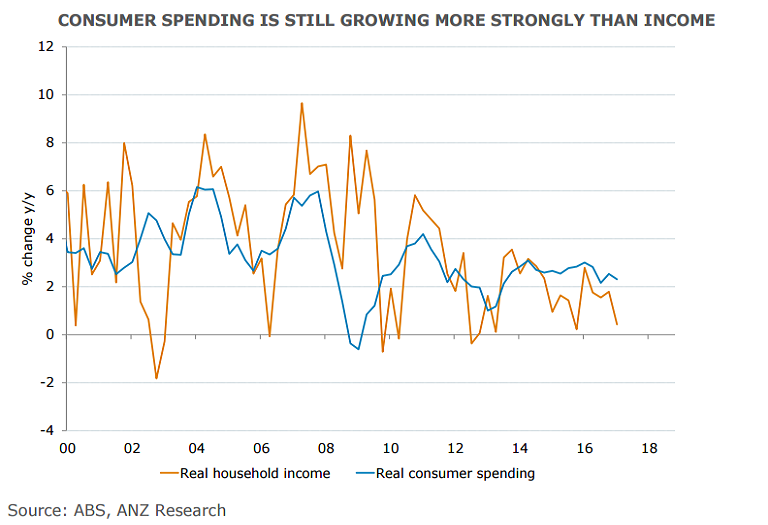
Australia's Q1 GDP report released on Wednesday came in largely in line with market forecasts but weaker than the implied quarterly forecast published in the RBA’s May Statement on Monetary Policy. Australia's GDP rose by a modest 0.3 percent q/q in Q1, compared to 0.2 percent estimated in Reuters poll. The annual growth was down to 1.7 percent from 2.4 percent in Q4. This is the lowest rate of growth since 2009.
The slightly better than expected data came one day after the Reserve Bank of Australia (RBA) cautioned that growth "is expected to have slowed in the March quarter." The central bank held rates unchanged at 1.50 percent and said it remains upbeat on the global outlook, domestic business conditions, and non-mining investment outside the regions impacted by the mining downturn.
Australia's economy just managed to squeeze out enough growth to stay out of a recession for the 26th year running. That said, as households struggle with paltry wage rises and punishing debt, its sustenance is in doubt. Unit labour costs rose 0.6 percent q/q, but are only 0.1 percent higher than a year ago suggesting an absence of domestic inflationary pressures and confirming that the RBA is on hold for some time.
The inflation indicators extended weakness. The household consumption deflator rose just 0.3 percent q/q, while the core rate was up just 0.2 percent and is only 0.8 percent higher over the year. The weak GDP data for Q1 will not unsettle the Reserve Bank of Australia (RBA) as it had expected a weak result.
"There looks to have been a sustained step-down in the pace of consumer spending growth as households adjust to the new world order of very low wage growth. On that front, wages growth actually picked up in the quarter, but growth in unit labour costs remains negligible, which suggests that inflation is likely to stay low. On this whole, this confirms our view that the RBA is on hold for some time," said ANZ Markets in a research note.
Aussie buoyed after Australia Q1 GDP beats estimates. AUD/USD rose to 0.7566, the highest level since April 25, and is currently hovering at session highs. The pair has broken 200-DMA at 0.7531 and close above will see further upside.
FxWirePro's Hourly AUD Spot Index was at 96.6914 (Bullish), while Hourly USD Spot Index was at 33.229 (Neutral) at 1145 GMT. For more details on FxWirePro's Currency Strength Index, visit http://www.fxwirepro.com/currencyindex.







