


 Stuck in a creativity slump at work? Here are some surprising ways to get your spark back
  Google promotes ‘teacher approved’ apps for kids. Here’s what parents should know
  How to support someone who is grieving: five research-backed strategies
  The pandemic is still disrupting young people’s careers
  Office design isn’t keeping up with post-COVID work styles - here’s what workers really want
  Glastonbury is as popular than ever, but complaints about the lineup reveal its generational challenge
  ING Says Yen Is 20% Undervalued Against Dollar
  Goldman Sachs Names 9 Top Japanese Semiconductor and Electronics Stocks
  Want to cut your energy bills? Here’s how five experts are doing it
  Time to buy local: war fuel price shocks reveal the folly of a long food supply chain
  Booked to travel through the Middle East? Here’s why you shouldn’t cancel your flight
  Every generation thinks they had it the toughest, but for Gen Z, they’re probably right
  Why have so few atrocities ever been recognised as genocide?


 Add as a preferred source on Google

Editor’s note: Muslims all over the world will begin celebrating Eid al-Fitr, one of the religion’s principal festivals, on or around June 4, 2019. In August, Muslims will celebrate Eid al-Adha. Ken Chitwood, a scholar of global Islam, explains the two Islamic festivals.
1. What is Eid?
Eid literally means a “festival” or “feast” in Arabic. There are two major eids in the Islamic calendar per year – Eid al-Fitr earlier in the year and Eid al-Adha later.
Eid al-Fitr is a three-day-long festival and is known as the “Lesser” or “Smaller Eid” when compared to Eid al-Adha, which is four-days-long and is known as the “Greater Eid.”
2. Why is Eid celebrated twice a year?
The two Eids recognize, celebrate and recall two distinct events that are significant to the story of Islam.
Eid al-Fitr means “the feast of breaking the fast.” The fast, in this instance, is Ramadan, which recalls the revealing of the Quran to Prophet Muhammad and requires Muslims to fast from sunrise to sundown for a month.
3. How do Muslims celebrate Eid al-Fitr?
Eid al-Fitr features two to three days of celebrations that include special morning prayers. People greet each other with “Eid Mubarak,” meaning “Blessed Eid” and with formal embraces. Sweet dishes are prepared at home and gifts are given to children and to those in need. In addition, Muslims are encouraged to forgive and seek forgiveness. Practices vary from country to country.
In many countries with large Muslim populations, Eid al-Fitr is a national holiday. Schools, offices and businesses are closed so family, friends and neighbors can enjoy the celebrations together. In the U.S. and the U.K., Muslims may request to have the day off from school or work to travel or celebrate with family and friends.
In countries like Egypt and Pakistan, Muslims decorate their homes with lanterns, twinkling lights or flowers. Special food is prepared and friends and family are invited over to celebrate.
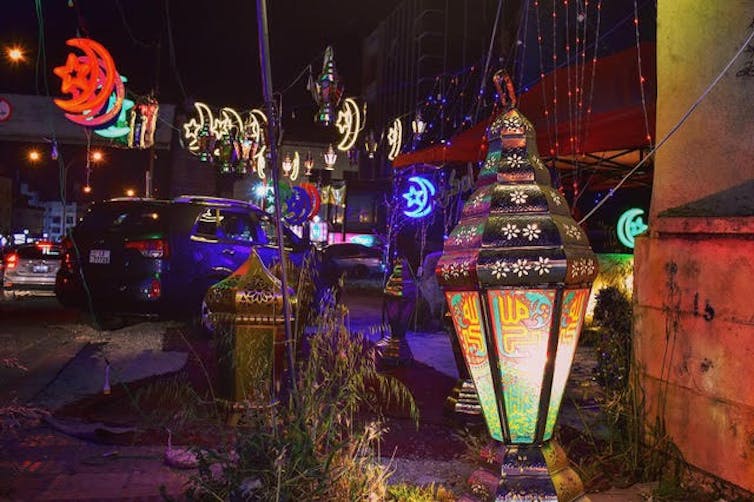
Fanous, the colorful lanterns of Ramadan, light up the streets of Amman, Jordan, throughout the holy month of fasting. Ken Chitwood, CC BY
In places like Jordan, with its Muslim majority population, the days before Eid al-Fitr can see a rush at local malls and special “Ramadan markets” as people prepare to exchange gifts on Eid al-Fitr.
In Turkey and in places that were once part of the Ottoman-Turkish empire such as Bosnia and Herzegovina, Albania, Azerbaijan and the Caucasus, it is also known as the, “Lesser Bayram” or “festival” in Turkish.
4. How do Muslims celebrate Eid al-Adha?
The other festival, Eid al-Adha, is the “feast of the sacrifice.” It comes at the end of the Hajj, an annual pilgrimage by millions of Muslims to the holy city of Mecca in Saudi Arabia that is obligatory once in a lifetime, but only for those with means.
Eid al-Adha recalls the story of how God commanded Ibrahim to sacrifice his son Ismail as a test of faith. The story, as narrated in the Quran, describes Satan’s attempt to tempt Ibrahim so he would disobey God’s command. Ibrahim, however, remains unmoved and informs Ismail, who is willing to be sacrificed.
But, just as Ibrahim attempts to kill his son, God intervenes and a ram is sacrificed in place of Ismail. During Eid al-Adha, Muslims slaughter an animal to remember Ibrahim’s sacrifice and remind themselves of the need to submit to the will of God.
5. When are they celebrated?
Eid al-Fitr is celebrated on the first day of the 10th month in the Islamic calendar.
Eid al-Adha is celebrated on the 10th day of the final month in the Islamic calendar.
The Islamic calendar is a lunar calendar, and dates are calculated based on lunar phases. Since the Islamic calendar year is shorter than the solar Gregorian calendar year by 10 to 12 days, the dates for Ramadan and Eid on the Gregorian calendar can vary year by year.
6. What is the spiritual meaning of Eid al-Fitr?
Eid al-Fitr, as it follows the fasting of Ramadan, is also seen as a spiritual celebration of Allah’s provision of strength and endurance.
Amid the reflection and rejoicing, Eid al-Fitr is a time for charity, known as Zakat al-Fitr. Eid is meant to be a time of joy and blessing for the entire Muslim community and a time for distributing one’s wealth.
Charity to the poor is a highly emphasized value in Islam. The Quran says,
“Believe in Allah and his messenger, and give charity out of the (substance) that Allah has made you heirs of. For those of you who believe and give charity – for them is a great reward.”
This piece incorporates materials from an article first published on Aug. 28, 2017.







