


 Oil Prices Slip as Oversupply Concerns and U.S.-Iran Talks Shape Market Outlook
  Goldman Sachs Says China Competition Weighs More on EU Growth Than Trade Deficit
  Despite its best efforts, Iran won’t be able to toll the Strait of Hormuz. Here’s why
  US Stock Futures Hold Steady Ahead of June Jobs Report as Fed Rate Outlook Remains in Focus
  Asian Stocks Rebound as Tech Shares Rally on Fed Rate Cut Hopes and Easing Iran Tensions
  Buy the Dip: Gold Holds Strong at $3980, Targets $4150
  Mary Daly Says AI Uncertainty Clouds Fed Rate Outlook Despite Restrictive Policy
  New Zealand Consumer Confidence Rises in June as Inflation Expectations Ease
  Japan Signals Readiness to Act on Yen as Intervention Speculation Grows
  State of emergency in Crimea as Ukraine focuses pressure on ‘jewel in Putin’s crown’
  Asian Currencies Stay Under Pressure as Dollar Holds Near 13-Month High Ahead of U.S. Jobs Report
  Gold Price Surges Above $4,120 as Weak US Jobs Data Lowers Fed Rate Hike Expectations
  Wall Street Ends Mixed as Weak Jobs Data Lowers Fed Rate Hike Bets, Chip Stocks Tumble
  Alcohol is one of the most dangerous drugs, yet its presence is ubiquitous in social settings and celebrations
  Trump has made more than $1 billion from crypto in a year. How?


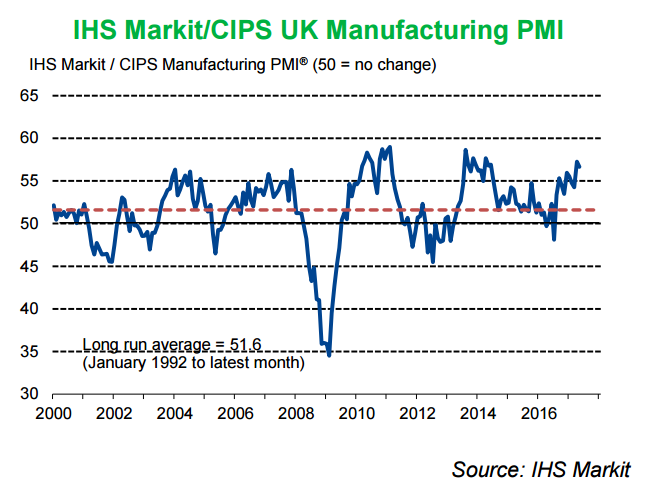
The seasonally adjusted IHS Markit/CIPS Purchasing Managers’ Index for May released on Thursday showed that UK’s manufacturing sector remained resilient in May. UK May manufacturing PMI dipped only slightly to 56.7 from 57.3 in the previous month, broadly in line with expectations. A modest dip was expected after the outsized gain in April. The ongoing strength of the domestic market proved to be the main driver of the upturn.
Details of the report showed solid expansions of production and new orders across the consumer, intermediate and investment goods categories. The continued strength of the domestic market lent solid support. There was also a solid increase in new export business as well. Rates of inflation in input costs and output charges remained elevated in May, despite easing further from recent highs. Despite easing to a five-month low, the increase in selling prices was still among the fastest seen in the survey history.
Optimism regarding the outlook for production levels in one year’s time improved to a 20-month high, with 56 percent of manufacturers forecasting output to rise during the next 12 months. The positive steer for output expectations was reinforced by a further increase in outstanding orders, which rose to a six-year high. The rate of jobs growth increased for a fourth-consecutive month.
"The elevated level of the PMI suggests that the contribution of manufacturing to UK GDP growth in 2017 is likely to be more positive than in recent months. That view is supported by the newly introduced future expectations balance, which at 75.0 is at a 20-month high, well above the 50 no-change mark," said Lloyds Bank in a report.
Nevertheless, manufacturing sector accounts for only around 10 percent of UK economic activity. Focus will remain on the dominant services sector and next Monday’s service PMI data will reveal a better picture of the overall outlook for UK economic activity. A downside surprise cannot be ruled out in the wake of a new poll that suggests that Prime Minister Theresa May’s Conservative Party could lose its majority in Parliament – a prospect that would further heighten uncertainty about the path ahead for Brexit negotiations.
Pound slipped as UK manufacturing activity fell in May. GBP/USD was down 0.3 percent and was trading at 1.2853 at around 1115 GMT. At the same time FxWirePro's Hourly GBP Spot Index was bullish at 99.0407 levels. For more details on FxWirePro's Currency Strength Index, visit http://www.fxwirepro.com/currencyindex.







