


 U.S. Imposes 25% Tariff on Select Brazilian Imports After Section 301 Trade Investigation
  AI Chip Stocks Face Valuation Pressure as Investors Shift Toward Big Tech and Software
  Port of Los Angeles Posts Record June Cargo Volume as Importers Rush Ahead of U.S. Tariffs
  European Earnings Season Gains Strength as Barclays Sees Broader Profit Recovery
  Gold Prices Slip as Oil Rally Fuels Inflation Fears, Strengthens Dollar
  Wall Street Ends Lower as AI Selloff, Iran Tensions Weigh on Tech Stocks
  ECB Expected to Hold Rates as Middle East Tensions Keep September Hike in Focus
  UBS Boosts China Tech Bets, Adds Kuaishou and Meituan to Focus List
  Asian Stocks Rise as Softer U.S. Inflation Boosts Sentiment Despite Middle East Tensions


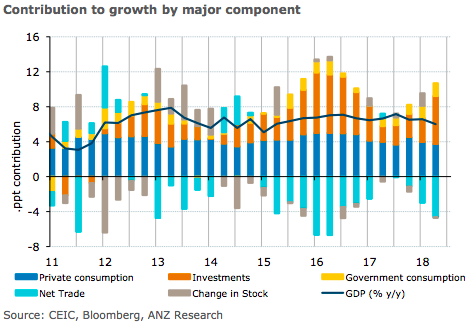
Philippines’ gross domestic product (GDP) for the second quarter of this year, failed to meet market expectations, coming in at 6.0 percent y/y and 1.3 percent q/q on a seasonally adjusted basis, compared to consensus estimates of 6.7 percent y/y. Net exports remained a drag on the overall performance, although domestic demand remained solid with its contribution to headline growth the highest in seven quarters.
At the component level, a 21.2 percent y/y growth in fixed capital formation underpinned the expansion in domestic demand. Private and government consumption grew at a slightly milder pace than that in the first quarter but still recorded solid growth of 5.7 percent y/y and 11.9 percent y/y, respectively. Inventories declined and were a modest drag on overall growth, ANZ Research reported.
Primarily owing to strong import growth of 19.7 percent y/y, the contribution of net exports to overall growth plummeted to -4.7 percentage points. This drag from net exports was the highest since Q2 2016.
"Based on realised H1 growth of 6.3 percent y/y, we are revising our full year 2018 GDP estimate to 6.6 percent from 6.8 percent previously. This downward revision notwithstanding, we remain of the view that domestic demand conditions remain strong and are the principal cause for the deterioration in the trade balance and accelerating inflation," the report commented.







