


 Michael Burry Shorts Tesla at $416 as AI and Semiconductor Bearish Bets Expand
  Buy the Dip: Gold Holds Strong at $3980, Targets $4150
  Alcohol is one of the most dangerous drugs, yet its presence is ubiquitous in social settings and celebrations
  Trump has made more than $1 billion from crypto in a year. How?
  Goldman Sachs Says China Competition Weighs More on EU Growth Than Trade Deficit
  JPMorgan Cuts Gold Price Forecast, Sees Bullion Reaching $4,500 by End of 2026
  Morgan Stanley Names BAE Systems Top European Defence Stock Despite Lower Price Target
  USA at 250: the Black American struggle for life, liberty and the pursuit of happiness
  AI can be a personal trainer in your pocket – but is it safe?
  In a rebuke to Trump, the Supreme Court rules that birthright citizenship is the law of the land
  Elon Musk is remaking the world, like Henry Ford before him – but more dangerously


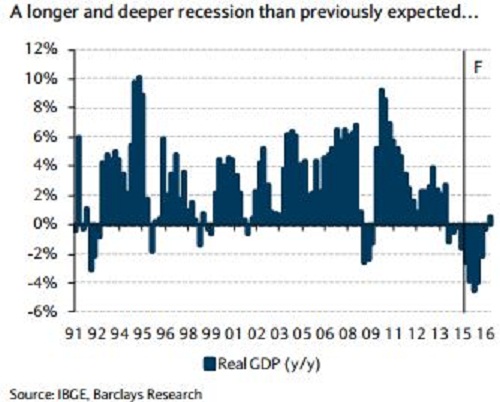
Analysts and economists at different investment banks are unanimous over one thing at least, Brazil's economic situation is quite bad and it is likely to get worse going ahead.
According to latest projection by economists at Barclays, Brazil is likely to face much prolonged recession than originally assumed.
Key problems -
- Brazil is facing worsening current account deficit, due to weaker commodity prices, lower demand for exports due to weakness in China, lower value of Real, deteriorating terms of trade for Brazil.
- Current President Dilma Rousseff's government is struggling to balance budget in a time of recession and heavy political protests. This means fiscal deficit is likely to remain large for quite some time now.
- The president might face impeachment as protest rise all across country and there are rebellions within her own party.
- Facing crisis, domestic demand in Brazil is likely to drop further.
Economists at Barclays are expecting Brazil to face much deeper recession this year, with economy shrinking as much as -3.2% against previous prediction of 1.1% contraction.
Brazilian Real is currently trading at 3.784 per Dollar, down more than 47% this year so far. Further downside is likely.







