


 Is space worth the cost? Accounting experts say its value can’t be found in spreadsheets
  SpaceX’s Starship Completes 11th Test Flight, Paving Way for Moon and Mars Missions
  NASA's Artemis II Mission: First Crewed Lunar Journey Since Apollo
  Trump Administration to Launch Autism Initiatives Targeting Acetaminophen Use and New Treatment Options
  SpaceX Pivots Toward Moon City as Musk Reframes Long-Term Space Vision
  FDA Lifts REMS Requirement for CAR-T Cell Cancer Therapies
  Tabletop particle accelerator could transform medicine and materials science
  Eli Lilly’s Inluriyo Gains FDA Approval for Advanced Breast Cancer Treatment
  Blue Origin’s New Glenn Achieves Breakthrough Success With First NASA Mission
  Trump Signs Executive Order to Boost AI Research in Childhood Cancer


The civil engineer, the science communicator or the physicist? That was the question Royal Bank of Scotland asked the public as part of its plans for a new £10 note in 2017. Science communicator Mary Somerville was declared the winner, beating the engineer Thomas Telford and the physicist James Clerk Maxwell – despite a row over rigging that delayed the announcement by a few days. The poll was supposed to be about choosing a Scot with significant achievements in science and innovation, but it became a question about gender.

Ten-pound Mary Wikimedia
The issue raises awkward questions about the inclusion of women in the history of science, not to mention how the UK and other countries choose who appears on their money. Somerville, whose selection followed a campaign last year to have more women on bank notes, was the author of a pair of influential books in the 1830s that introduced the latest research in the physical sciences to a wider audience.
It is hard to argue that her achievement is greater than that of Telford, who rose from shepherd’s son to president of the Institute of Civil Engineers, whose canals, bridges, roads and harbours across the British Isles are still used to this day. And Maxwell developed no less than the theory of electromagnetism, one of the most important contributions to physics in the past millennium, and a vital precursor of everything from Einstein to the new discovery of gravitational waves.
The trouble is that no woman in that period could have matched the scientific achievements of these men. If you want to choose a Scottish woman of historic importance, you either have to go for someone like Somerville or maybe one of the first university graduates in the late 19th century such as Sophia Jex-Blake and the rest of the so-called “Edinburgh seven”, the first women in the UK to graduate in medicine. You can’t choose a woman from that era without drawing attention to the way in which they were seen as having no place in the likes of science and higher education. It is a certainly an argument for broadening our commemorative choices beyond the sciences – and not the only one, as we shall see.
The safety of science
You have to ask why RBS was looking to commemorate achievement in “science and innovation” in the first place. It is a surprisingly common theme on bank notes in Britain and elsewhere. While the notes of the US proudly carry portraits of (male) presidents and prime ministers, Britain has tended to avoid politicians – which will actually make Winston Churchill’s imminent arrival something of a novelty on the Bank of England £5 note, on the flip side from the Queen.

Stand by for Winston.
Politicians tend to be a divisive choice, so avoiding them makes a lot of sense. There’s a reason why the euro notes have bridges on them. Scientists seem to be placed in the same uncontroversial category (which displays a certain amount of ignorance of the history of science, but that’s another story). We celebrate historical science figures for their intellectual achievements, while simultaneously proclaiming a proud national tradition of science and innovation that is so beloved of modern governments.
The Canadian bank notes are particularly clear in their determination to “celebrate Canada’s spirit of innovation”: their backs showcase space-station robotics, the railway through the Rockies, and ice-breaking research ships.

Canadian space commemoration. Bank of Canada, CC BY-SA
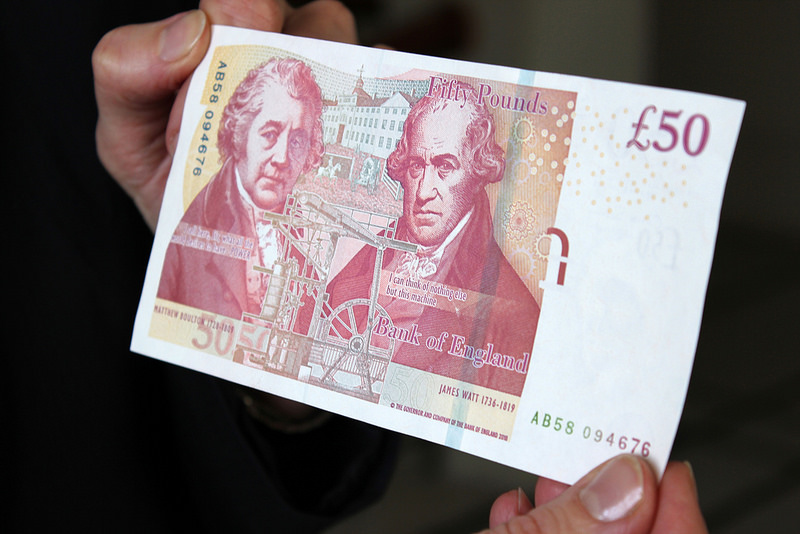
The British science celebration is slightly more muted, but nonetheless clear. Bank of England notes currently feature Charles Darwin and the steam-engine developers James Watt and Matthew Boulton (see lead image), while past issues have celebrated Isaac Newton, Michael Faraday and railway engineer George Stephenson. The Clydesdale Bank currently has Alexander Fleming, of penicillin fame, and used to have the physicist and engineer William Thomson (Lord Kelvin). In this context, it is hardly surprising that RBS decided to feature science on its new £10 note.
Ask Australia
But science is not the only thing that Britain should be proud of. It ignores the wealth of activities that have contributed to the nation’s heritage and to its current standing in the world, and limits the opportunities to promote other political points. The Australians have women from various fields on their bank notes – the businesswoman and ex-convict Mary Reibey; the politician Edith Cowan; and the opera singer Nellie Melba. And though their $50 note features inventor and science communicator David Unaipon, the fact that he was an Aborigine makes its own point.

G'day. Kara Brugman, CC BY-SA
To be fair to the British, there are some exceptions. The Bank of England and Scotland’s Clydesdale Bank do celebrate philanthropy and good works (prison reformer Elizabeth Fry for the Bank of England; missionary Mary Slessor, and nurse Elsie Inglis for Clydesdale); and authorship (Clydesdale carries Robert Burns and the Bank of England carries Charles Dickens and soon Jane Austen). These choices are undoubtedly better than the well worn politicians, kings and military leaders who adorn our Victorian civic spaces. But there’s so much more to celebrate about human and national achievement – and plenty contemporary social causes to champion, if that is what RBS wishes to do.
What we need from our banks is a clear vision for a series of notes that will together represent both men and women, a fuller range of human activity – and perhaps even some parts of history other than the late 18th and 19th centuries.
Aileen Fyfe does not work for, consult, own shares in or receive funding from any company or organization that would benefit from this article, and has disclosed no relevant affiliations beyond the academic appointment above.
Aileen Fyfe, Reader in Modern British History, University of St Andrews
This article was originally published on The Conversation. Read the original article.








