


 Oil Prices Rebound as Strait of Hormuz Tensions Return After Ship Attack Near Oman
  The government is ‘doubling down’ on its social media ban. But bigger penalties for platforms aren’t enough
  Morgan Stanley Sees Chinese Auto Market Recovery Gaining Momentum in Late Summer
  Economic pessimism has set in – but there are reasons for Australians to be hopeful
  Canada Grants C$7 Million to Greenland Molybdenum Mine to Strengthen Critical Minerals Supply
  World Bank Approves $1.1 Billion Emergency Funding for Bangladesh Amid Food and Energy Price Pressures
  Asian Stocks Sink as Apple Price Hikes Spark AI Valuation Fears, South Korea and Japan Lead Selloff
  Oil Prices Drop as Middle East Supply Recovery Eases Market Concerns
  China Sets 1.25% Overnight Reverse Repo Rate Below Market Expectations
  Part II — The listing: NFTs as bottle-stamps, and a vault the family is in no rush to sell
  South Korea’s KOSPI Plunges as Apple Price Hikes and OpenAI IPO Delay Shake AI Chip Stocks
  Gold Price Ends Lower for Fourth Week Despite Rebound as Fed Rate Hike Bets Strengthen
  Gold Surges Above Key EMAs, Bulls Eye Resistance Amidst Bullish Momentum




Among all the uncertainty Brexit is causing, concerns have arisen over the potential fuel it is adding to the pertinent problem of inequality. There is mounting evidence that post-Brexit, the economic and social disparities between the stronger and weaker UK regions will widen.
Looking at a number of potential scenarios, estimates suggest that the poorest regions could be between 20% to 60% more exposed to the economic risks than London. Wales and the north-east are among the regions most likely to be affected because they rely so heavily on exporting food and goods to Europe.
But while leaving the EU may be inevitable, the people and sectors in these regions needn’t be left behind. Moves are now being made to work out how to support these local economies nationally. While attracting new business to different regions is important, policy makers and established businesses are also looking at how supporting the basics of the country’s economy – formed from things like utility networks, food and health services – could protect these areas from economic problems after Brexit.
Known as the foundational economy, these “basics” are all the goods and services that provide the social and material infrastructure for society. That includes the provision of primary resources (for example, health services, care and education) as well as the infrastructure that allows society to function (utility networks, pipes, telecommunications, broadband), and everyday, largely essential, consumption activities (food, tourism, hospitality, retail). Together these three components currently employ 63.8% (17.6%, 26.2% and 20% respectively) of all UK employees. They account for up to 30% of weekly household expenditure. While a large part of the economy, these sectors often get ignored in favour of high value activities such as financial services, advanced manufacturing and life sciences.
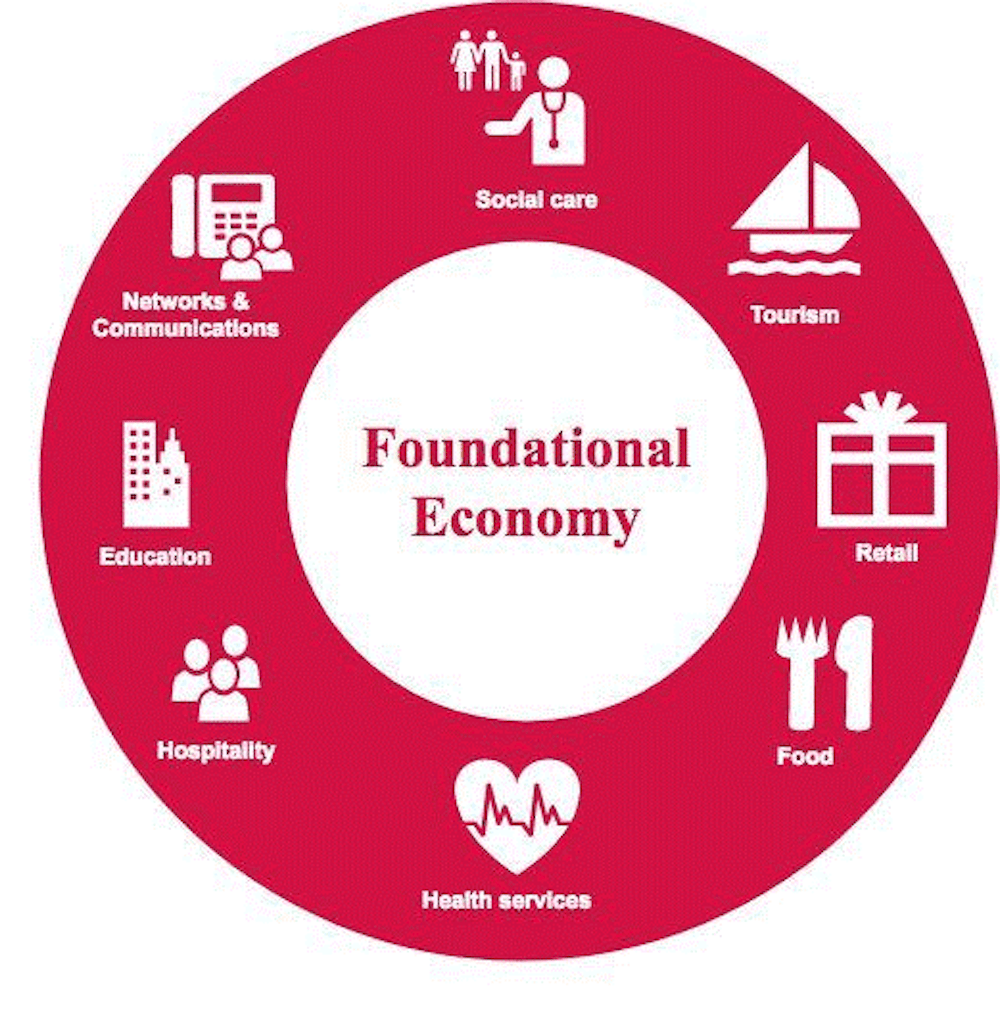
The foundational economy encompasses a range of different areas, as shown above. Author provided
Traditionally, public policy has most overlooked the foundational economy. In part this was because of its low wage, low skilled and perceived low value composition. Yet it is largely local and rarely bought or sold outside of the UK - meaning the sectors are resilient to economic shocks like Brexit. When measuring the economic impacts of the UK leaving the EU, predictions are being made based on dependency on EU trade. Since foundational sectors are less impacted by imports and exports it is hoped that they might provide some relief during the transition.
Emerging policy
Policy makers in Wales have already begun to adopt some foundational economy principles. The 2018 Prosperity for All Economic Action Plan incorporated four “foundation sectors”. These are tourism, retail, food and care. Building on this, in February 2019 the Welsh government released £1.5 million to fund experimental projects that challenge conventional ways of prompting productivity and growth in these sectors. Motivations for these changes include the need to deliver better jobs closer to home and spark regional economic development.
There are signs that the foundational economy is finding its way into the UK’s political discussions too. At a regional level, it is beginning to gain traction in the trailblazing local industrial strategies. These place-based policies build upon the UK government’s move toward local approaches to industrial development and economic growth. The first draft of the Greater Manchester Combined Authority’s strategy, for example, places the foundations of economy as one of its central objectives.
But while policy is certainly needed to encourage more focus on the foundational economy, it is not the only thing that will help it grow. Our own research, for example, shows that technology is vital to encourage development of these sectors. Technological innovations – including artificial intelligence, biotech, big data, cloud technology, internet of things, robotics and space technology – are already changing the way businesses operate. And while these developments are most celebrated in the high value parts of the economy, they can help the seemingly more everyday parts too.
Though there will certainly be challenges, our early indications show that investing in technology that is supported by ultra fast fibre and mobile broadband technologies will make for positive long-term incremental changes across the foundational sectors. These include increased innovation, business efficiency and value for customers.
While a new focus on the foundational economy won’t solve all of the UK’s regional inequality problems after Brexit, encouraging growth in these sectors can help. But that is only so long as more policy is put in place to support this. The country will need to incorporate these often taken for granted products and services into national policy and practice. Only then can their value be truly realised, particularly in an uncertain political, economic and technological landscape.







