


 Petrobras Joins Brazil’s New Diesel Subsidy Program
  US Northeast Airports Resume Operations After Telecom Outage Disrupts Thousands of Flights
  Volkswagen Shares Slide After 2026 Profit Outlook Cut
  SpaceX Nasdaq 100 Weight to More Than Double in Rebalance
  FAA Allows Boeing to Sell 35 More 777F Freighters Beyond 2028
  White House Bars CNN, MS NOW and Politico Reporters
  Goldman Sachs Names Simon Lyons UK Investment Banking Co-Head
  Trump Bans CNN, MS NOW and Politico From White House
  Hyundai CEO Warns Chinese Automakers Could Disrupt US Market
  NASA, Boeing Discuss Expanding Starliner Missions
  Trump Plans Federal AI Force and AI Czar
  Paramount Skydance Faces $30 Million Film Penalty in Warner Bros. Deal
  Meta Partners With Shopify to Bring Shop Pay Checkout to Muse AI
  FCC Approves Foreign Investment in $110B Paramount-Warner Bros. Deal
  US Federal Register Drops Alibaba Qwen AI Search Tool
  China Vanke Shares Jump as Beijing Moves to Ease Debt Pressure
  CNN, MS NOW and Politico Sue Trump Over White House Media Ban


 Add as a preferred source on Google
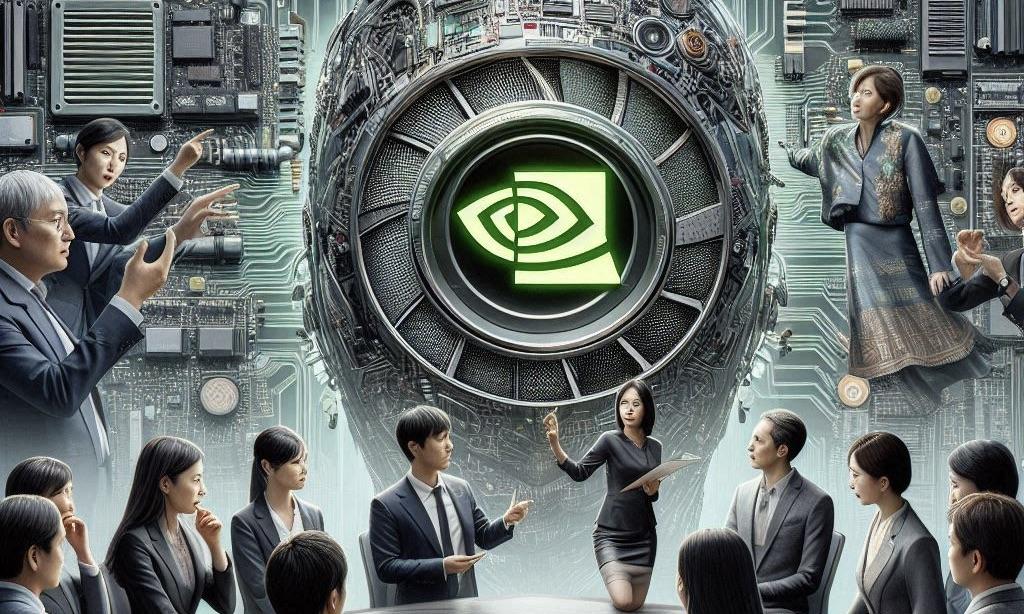
At the Goldman Sachs Communacopia + Technology conference, NVIDIA CEO Jensen Huang revealed the company's ability to pivot from its primary supplier, TSMC, if necessary. Huang emphasized that NVIDIA remains poised to capture opportunities in a $1 trillion market beyond AI.
NVIDIA CEO Highlights Future Growth, Supply Chain Flexibility, and Opportunities Beyond AI at Conference
NVIDIA CEO Jensen Huang disclosed critical insights regarding the organization's future at the Goldman Sachs Communacopia + Technology conference. This event resulted in a 10% increase in NVIDIA's stock price, which opened higher on September 12. Even though the broader industry has not fully adopted artificial intelligence (AI), Huang emphasized that the demand for NVIDIA's products will remain sustainable due to the fundamentals of semiconductor fabrication.
Huang also elaborated on NVIDIA's capacity to mitigate potential supply chain disruptions, stating that the company has improved its semiconductor design capabilities to guarantee the continued provision of GPUs by swapping partners if necessary, particularly in the event of a disruption with its primary manufacturing partner, TSMC.
Huang initiated the discussion regarding AI's influence on NVIDIA's expansion by imagining a scenario in which AI does not exist. He clarified that the constraints of general-purpose computing would continue to exist, even without artificial intelligence, because the physical principles that underlie Denard scaling and transistor shrinkage are no longer viable. Consequently, Huang thinks that the industry will no longer witness the annual doubling of the performance of CPUs or general-purpose computers. He emphasized that, in the current environment, companies must not wait for CPUs to become speedier; instead, they must account for "computation inflation."
Huang recommended that industries prioritize accelerating all processes, including SQL processing, data processing, and recommender systems, to adjust to this reality. He believes that this requirement for accelerated computation is the least risky market opportunity for NVIDIA.
NVIDIA CEO Discusses Data Center Transformation, Cost Efficiency, and Supply Chain Resilience Strategies
Huang asserts that transforming the world's general-purpose data centers into accelerated computing centers is unavoidable, as Moore's Law is no longer the primary factor propelling performance improvements. He clarified that this transition would result in the "densification of computers," which involves consolidating enormous data centers into significantly smaller, more efficient facilities.
Huang emphasized the cost-saving advantages of NVIDIA's server racks, which may appear costly at first glance—possibly costing millions of dollars per rack—but supplant thousands of nodes in outdated systems. In addition, he observed that the cost of cabling for antiquated systems frequently surpasses the cost of consolidating into a single rack. He also mentioned that densification facilitates more efficient liquid cooling in data centers.
Huang compared the complexity of modern GPUs to earlier products he had designed in response to a query about how NVIDIA would manage potential disruptions in Asia. He clarified that the present-day GPUs comprise 35,000 components, weigh 80 pounds, and consume 10,000 amps. These GPUs are constructed like electric vehicles, weighing 3,000 pounds when stacked. The production ecosystem in Asia is highly interconnected and diverse.
To reduce risks, NVIDIA incorporates diversity and redundancy into every stage of its manufacturing process, guaranteeing the capacity to transfer production to an alternative facility in an emergency. Despite the potential for decreased performance or increased costs as a result of a manufacturing transition, Huang acknowledged that the company would continue to be able to supply products. He concluded by lauding TSMC, NVIDIA's primary partner, as the finest in the world by a substantial margin.







