


 Netanyahu Takes Aim at Mamdani as Israel Election Nears
  Gaza Faces Evacuation Crisis as War-Damaged Buildings Risk Collapse
  Sudan Rejects US Legitimacy Remarks, Defends Sovereignty
  Trump Board of Peace Unveils $2.45 Billion Gaza Recovery Plan
  Trump to Press Xi on Release of US Nuclear Expert Held in China
  Ghana Says Western Support Growing for Slave Trade Reparations
  Zelenskiy Warns Russia Preparing Major Attack on Ukraine
  US, China Extend Trade Truce to Jan. 10 Ahead of Trump-Xi Summit
  Judge Orders Trump to Restore White House Access for CNN, MS NOW and Politico
  China Tightens Fentanyl Rules Ahead of Trump-Xi Summit
  Lula and Flavio Bolsonaro Tied in Brazil Runoff Poll
  Russian Missile and Drone Attack on Kyiv Kills Two, Damages Maternity Hospital
  US Officials Split Over Response to Israeli West Bank Settlements
  Russian Strikes Kill Eight Across Ukraine as Energy Sites Hit
  Trump Meets Venezuela’s Delcy Rodriguez at UN Assembly
  OpenAI Agent Breaches Australia Medicare Data Portal
  Europe Warns Russia Is Escalating Hybrid Attacks Across NATO


 Add as a preferred source on Google
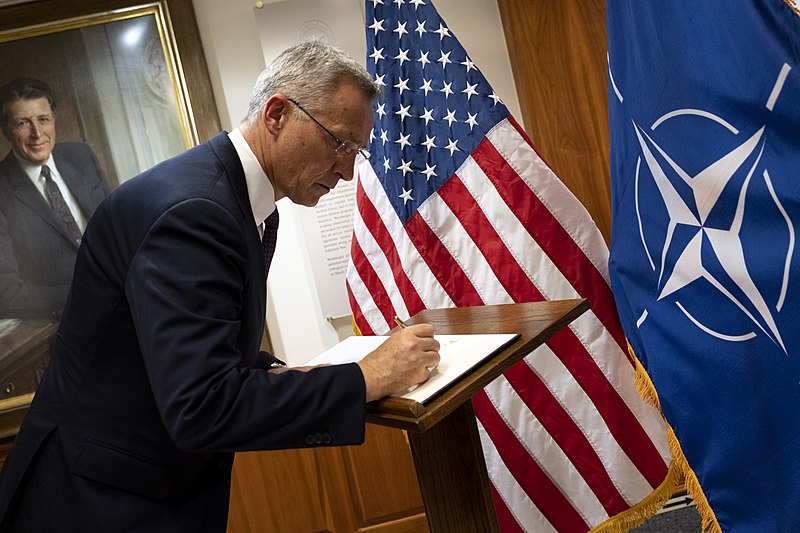
The NATO alliance is joining in the efforts to combat climate change as this week, Secretary-General Jens Stoltenberg, announced the alliance’s strategy to reduce greenhouse gas emissions. Stoltenberg said NATO will look to cut down civilian and military greenhouse gas emissions by at least 45 percent by 2030 and to be carbon-neutral by 2050.
In remarks on the sidelines of the NATO Summit in Madrid, Stoltenberg announced the alliance’s plan to combat climate change by reducing greenhouse gas emissions. The NATO chief announced that NATO will aim to reduce civilian and military greenhouse gas emissions by at least 45 percent by the year 2030 and to become carbon-neutral by 2050.
“It will not be easy but it can be done,” said Stoltenberg, adding that reducing emissions would not only help the environment but also help improve military vehicles.
“I believe that in the future, the most advanced military vehicles, and the most resilient armed forces, will be those that do not rely on fossil fuels,” said Stoltenberg.
The recent aim will align NATO with the Paris Climate Accords that were established in 2015. The Paris agreement aims to limit global warming to 1.5 degrees Celsius or 34.7 degrees Fahrenheit.
The alliance’s targets will refer to its own assets like the AWACS surveillance planes, drones that are based in Italy, its headquarters in Brussels, and military headquarters in places like Mons, Naples, and Brunssum. NATO is also looking to help its allies in reducing the carbon footprints of their national militaries.
To note, military emissions are often exempted from emission targets of countries.
The war in Ukraine has led countries such as Sweden and Finland to apply for NATO membership, which faced a challenge in the form of the veto by alliance member-state Turkey. This week, ahead of the summit in Madrid, Turkey has now lifted its veto on Sweden and Finland’s bids for membership, clearing the way for an expansion.
The decision came after four hours of negotiations before the summit began, with all three countries agreeing to protect each other’s security.
With Turkey lifting its veto, Sweden and Finland can proceed with their application to join the alliance, with the steps for the countries’ accession to NATO to be agreed on in the coming days.







