


 Trump Administration Plans Faster FDA Reviews for Smoke-Free Nicotine Products
  Ghana Says Western Support Growing for Slave Trade Reparations
  Lula and Flavio Bolsonaro Tied in Brazil Runoff Poll
  Judge Orders Trump to Restore White House Access for CNN, MS NOW and Politico
  Trump to Press Xi on Release of US Nuclear Expert Held in China
  China Tightens Fentanyl Rules Ahead of Trump-Xi Summit
  Russian Missile and Drone Attack on Kyiv Kills Two, Damages Maternity Hospital
  South Korea, US Discuss Warship Building Cooperation
  Russian Strikes Kill Eight Across Ukraine as Energy Sites Hit
  Trump Meets Venezuela’s Delcy Rodriguez at UN Assembly
  Europe Warns Russia Is Escalating Hybrid Attacks Across NATO
  US Officials Split Over Response to Israeli West Bank Settlements
  Kremlin Says No Grounds Yet for Ukraine Peace Talks
  Netanyahu Takes Aim at Mamdani as Israel Election Nears
  Marco Rubio to Meet Russia’s Lavrov in New York
  US, China Extend Trade Truce to Jan. 10 Ahead of Trump-Xi Summit
  Sudan Rejects US Legitimacy Remarks, Defends Sovereignty


 Add as a preferred source on Google
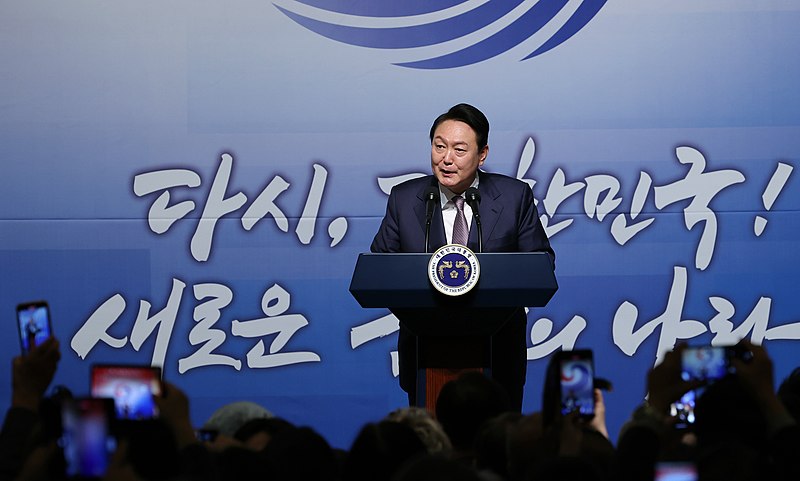
South Korea was recently confirmed to be taking part in the upcoming summit of the NATO alliance in Madrid this month. The country’s national security adviser said Seoul intends to establish a diplomatic mission to the alliance at the conference.
Reuters reports South Korea’s national security adviser Kim Sung-han told reporters regarding President Yoon Suk-yeol’s attendance at the summit in Spain that Seoul is looking to bolster relations with NATO countries amidst an “unpredictable” international situation.
South Korea is already in discussions with NATO on information sharing, combined exercises, and coordinated research to counter potential threats.
Yoon, who was inaugurated as South Korea’s new president in May, has aimed to make the country a “global pivotal state” with a focus on promoting freedom, peace, and prosperity based on the country’s liberal democratic values.
Kim also said that while the upcoming conference in Madrid will largely focus on the ongoing war in Ukraine, Yoon intends to rally global cooperation against North Korea’s nuclear program.
NATO chief Jens Stoltenberg said the upcoming summit is expected to sign off on an assistance package for Ukraine that will help the country transition to using NATO-standard military equipment instead of Soviet-era weapons.
South Korea’s Yonhap news outlet said Seoul is also planning to announce additional humanitarian aid for Ukraine at the meeting but not lethal aid.
The outlet added that Yoon may look to hold a trilateral meeting with US President Joe Biden and Japanese Prime Minister Fumio Kishida on the sidelines of the summit.
Last week, Yoon called for a coordinated response from the UN Security Council against Pyongyang’s increasing missile provocations, according to local news outlet Newsis.
Yoon made the remarks during his phone conversation with UN Secretary-General Antonio Guterres, in which he also called for close communication to assist North Korea in curbing the COVID-19 pandemic that the isolated nation is currently facing.
Yoon’s call for a coordinated response follows the vetoing of China and Russia of a US-led effort to impose new UN sanctions on North Korea over its repeated missile tests.
The double veto has led to a division in the 15-member council for the first time since it started to punish North Korea for its weapons tests back in 2006.







