


 Gold Falls Below $4,000 as Strong Dollar and Fed Rate Hike Expectations Weigh on Prices
  Wall Street Ends Mixed as Tech Stocks Struggle Ahead of Micron Earnings
  Asian Currencies Trade Mixed as Yen Hovers Near 40-Year Low, Dollar Holds Firm on Fed Outlook
  Best Gold Stocks to Buy Now: AABB, GOLD, GDX
  South Korea Remains MSCI Emerging Market Despite Reform Progress
  BOJ Hawk Signals Faster Interest Rate Hikes Amid Inflation Risks
  FxWirePro: Daily Commodity Tracker - 21st March, 2022
  Oil Prices Drop as Middle East Supply Recovery Eases Market Concerns
  Oil Prices Drop as Strait of Hormuz Shipping Recovers
  U.S. Dollar Reaches One-Year High as Tech Sell-Off and Fed Rate Hike Expectations Support Demand
  Bank Regulation Rollbacks in the U.S. and UK Could Increase Financial Risks, Study Warns


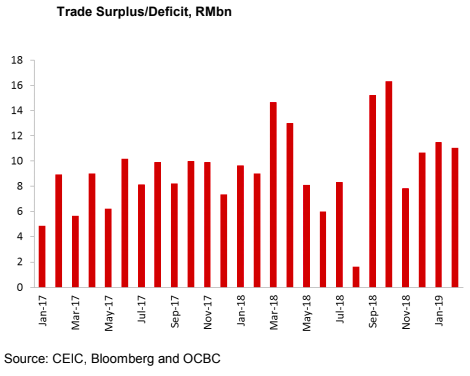
Malaysia’s trade data for February showed the country recording a surplus at RM11.06bn, little changed from the January number of RM11.52 billion. Exports did though record a decline of 5.31 percent y/y, the first since August 2018 whilst imports also fell by 9.43 percent y/y.
However, E&E exports did rise by 4.9 percent y/y, possibly proving that the country may still be in a good position to benefit in some way from the ongoing US – China trade tensions. The Malaysian E&E industry is after all known to be more flexible in quickly adapting to producing new products and hence, able to fill gaps left by China.
Anecdotal evidence also suggests that there is existing spare capacity which means the industry can more quickly respond to additional demand. However, this may also mean that the ongoing trade tensions may not lead to the sector attracting more investment.
Instead, it was commodity related exports which were a drag as petroleum related products, palm oil related products and rubber imports all fell. This could have been due to weaker commodity prices compared to the same time last year. There was an increase in LNG exports as prices were higher although export volumes were lower which possibly highlights continued production weakness in the sector.
On the import side, there wasn’t much good news as intermediate goods imports (57.4 percent of total imports) fell by 2.8 percent y/y reflecting that Malaysia is facing the effects of a global slowdown. Consumer goods and capital goods imports were similarly down too.
"Going forward, even as Malaysia may continue to run a trade surplus, import and export levels may remain subdued given the expected global slowdown in trade as highlighted by the WTO (World Trade Organization) early this week. Even if the US and China sign a trade deal, there are no assurances that they will lift tariffs immediately which is the major negative point on global trade. Oil prices at the same time face downside risk of Trump’s insistence on wanting crude prices to be lower. The palm oil sector meanwhile may be hurt by EU (European Union) attempts to restrict imports," OCBC Treasury Research commented.







