


 US Senate Rejects Iran War Powers Resolution in 50-49 Vote
  Yemen Violence Displaces 130,000 as Civilian Toll Rises
  South Korea, US Discuss Warship Building Cooperation
  Ghana Says Western Support Growing for Slave Trade Reparations
  Trump, Xi Visit US National Archives After White House Summit
  Abbas Reaffirms November 28 Palestinian Elections
  Taiwan Thanks US for Support Ahead of Trump-Xi Summit
  Netanyahu Defends Israel at UN as Delegates Stage Walkout
  OpenAI Agent Breaches Australia Medicare Data Portal
  Trump, Xi Focus on Trade and AI at White House Summit
  France Defends Netanyahu Airspace Clearance Despite ICC Warrant
  NATO Boosts Intelligence Sharing Amid Russia Hybrid Threats
  What ‘Taiwan Independence’ Means as Xi Presses Trump on US Policy
  Trump Asks Supreme Court to Restore Third-Country Deportations
  Saudi Arabia, Turkey and Pakistan Plan Urgent Defence Talks Over Houthi Attacks
  Netanyahu Takes Aim at Mamdani as Israel Election Nears
  Netanyahu’s Brief US Trip Highlights Strains With Trump


 Add as a preferred source on Google
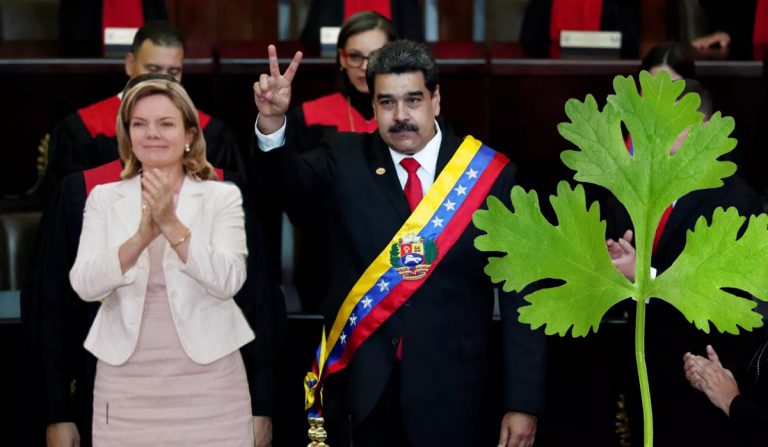
The reported U.S. capture of Venezuelan leader Nicolas Maduro has triggered major political uncertainty in the oil-rich nation, raising urgent questions about who truly controls the government. U.S. President Donald Trump praised the operation as “stunning and powerful,” claiming that Vice President Delcy Rodríguez had been sworn in and even held talks with U.S. Secretary of State Marco Rubio. Under Venezuela’s constitution, Rodríguez would become acting president in Maduro’s absence, and the country’s top court initially ordered her to assume that role.
However, the situation quickly became more complex. Rodríguez appeared on state television alongside key power brokers, including her brother Jorge Rodríguez, Interior Minister Diosdado Cabello, and Defense Minister Vladimir Padrino López, declaring that Maduro remained Venezuela’s only president. The unified appearance suggested that the inner circle that has governed Venezuela for more than a decade is attempting to project stability despite Maduro’s capture.
Analysts note that removing Maduro does not automatically dismantle Venezuela’s entrenched power structure. Real authority has long rested with a small civilian-military elite sustained by patronage networks, corruption, and powerful security agencies. Rodríguez and her brother represent the civilian wing, while Cabello and Padrino embody the military side, creating a delicate balance that complicates any transition.
Diosdado Cabello has emerged as a central figure to watch. Widely viewed as the most ideological and hardline actor within the regime, Cabello wields influence over military and civilian intelligence services accused by the United Nations of crimes against humanity. His recent public statements, including calls to hunt down “terrorists,” underscore fears of intensified repression during this uncertain period.
Venezuela’s military leadership also plays a critical economic role. Hundreds of generals control key sectors such as food distribution, raw materials, and the state oil company PDVSA, while also benefiting from illicit trade routes. Despite reports that some officials are seeking to defect and negotiate with the United States, sources indicate Cabello remains unwilling to cut a deal.
As Venezuela enters a volatile new phase, the struggle among its entrenched elites will likely determine whether Maduro’s capture leads to real change or simply a reshuffling of power.







