


 Fed Unveils Stablecoin Rules Under GENIUS Act
  Mexico-US Trade Talks Delayed to October as Tariff Negotiations Continue
  U.S. Dollar Hits Two-Month High as Oil, Treasury Yields Surge
  ECB May Stop Rate Hikes After December, Capital Economics Says
  US Stock Futures Fall as Treasury Yields Surge Ahead of Trump-Xi Summit
  South Korea Tax Windfall Could Top 50 Trillion Won on Chip Boom
  Fed Unveils Stablecoin Rules Under GENIUS Act
  Trump, Xi Focus on Trade and AI at White House Summit
  Fed’s Hammack Says Bond Yield Surge Is Not Driven by Inflation Fears
  Japanese Bank Stocks Surge as Bond Yields Fuel Rate Hike Bets
  Dollar Holds Near Two-Month High as Yen Approaches 160
  Wall Street Ends Flat as Oil, Treasury Yields and Fed Jitters Rattle Markets
  Trump to Ease U.S. Fuel-Economy Standards
  European Stocks Fall as Bond Yields and Geopolitical Risks Weigh
  Japanese Yen Rebounds as Trump Flags Currency Weakness
  Germany’s 2026 Growth Outlook Strengthens on Fiscal Spending
  US Stocks Face Jobs, Inflation Test as Fed Rate Hike Bets Rise


 Add as a preferred source on Google
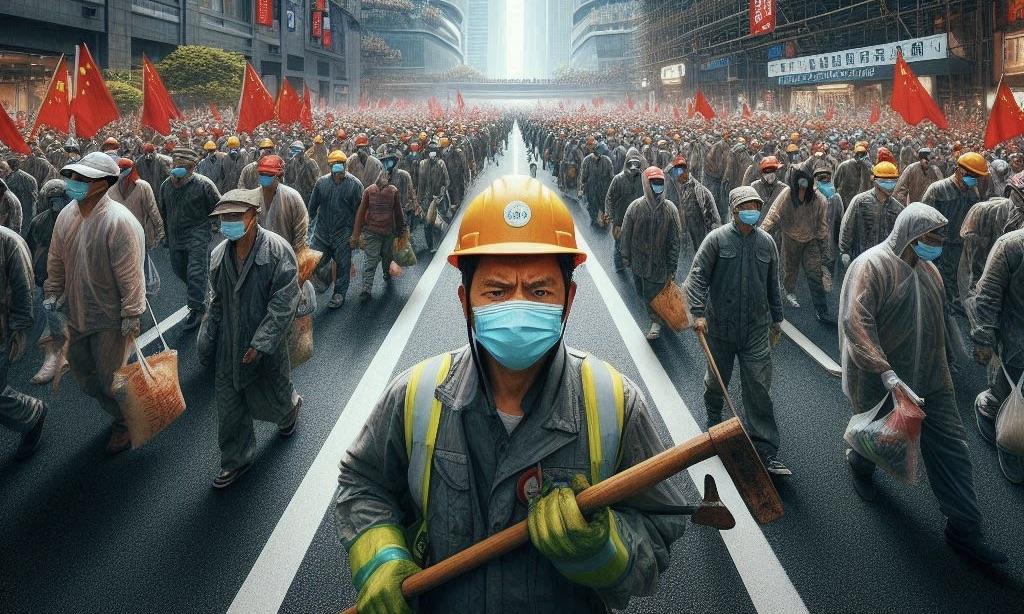
Labor strikes in China’s property and manufacturing sectors have surged as the country’s economic growth slows. According to the China Labor Bulletin, strikes increased by 3% in the first half of 2024, highlighting growing social pressures as workers express concerns over wages and social security.
China's Economic Slowdown Spurs Labor Disputes, Highlighting Worker Concerns Over Social Safety Net
The slowdown in economic growth has resulted in a surge in labor disputes in China's property and manufacturing sectors, underscoring the concerns of blue-collar workers regarding the country's social safety net. Even though the state-controlled media rarely reports unrest, indications of public discontent and hardship persist.
Recent incidents include a protest by an ex-soldier on August 1, who sat atop a building in Beijing’s Wangfujing shopping street. In a video posted on the social media platform X, the man, dressed in full army uniform, unfurled a white banner accusing a government office in Kunming, Yunnan province, of "strangling a retired serviceman who had served for 12 years."
Two days earlier, another protester, Fang Yirong, displayed a banner on an overpass in Xinhua County, Hunan province, demanding freedom and elections. In a video that spread on X, the protester claimed to have been targeted by authorities for supporting democracy and participating in the 2022 "white paper" protests against China’s COVID-19 restrictions.
Labor strikes in China increased by 3% year-on-year, reaching 719 incidents in the first half of 2024, according to the China Labor Bulletin (CLB), a Hong Kong-based workers' advocacy group. Strikes in the property and manufacturing sectors rose by 12%, accounting for 80% of the total. Max J. Zenglein, chief economist at the Mercator Institute for China Studies in Germany, noted that the uptick in strikes reflects the increasing social pressure as the economy struggles.
China’s economic growth slowed to 4.7% in the second quarter, down from 5.3% in the first, hindered by a persistent downturn in the property sector and subdued household demand. The sluggish domestic growth has pushed some industries, such as solar panels and automobiles, to increase exports, while those affected by trade tensions with the U.S. have sought to shift production abroad.
Worker unrest mirrors these growing pressures. Among the incidents highlighted in the CLB report was a dispute at solar panel maker Akcome Technology over pay cuts and the withdrawal of social security contributions. On July 29, Akcome filed for bankruptcy for one of its subsidiaries, citing an inability to repay debts.
Over 1,000 Workers Strike in China as Economic Struggles Highlight Wage Disparities and Social Security Gaps
CLB also reported a strike involving over 1,000 workers at Yangzhou Baoyi Shoe Manufacturing in Jiangsu province. The company supplies brands like Nike, Adidas, and New Balance. The strike occurred in November over compensation issues affecting laid-off workers after the company moved its production to Indonesia.
Zenglein pointed out that the economy has not significantly improved in 2024, with a weak labor market being a key source of household insecurity, dampening consumption. According to CLB, the most significant number of protests—344 incidents—were carried out by construction workers demanding wages, reflecting the financial difficulties many property developers face.
According to CLB (via Nikkei Asia), workers facing long hours and low wages typically lead to strikes in China. The disparity in social security coverage between urban and migrant workers is a significant issue, with many laborers from rural areas working without formal contracts despite being essential to their adopted cities' economies.
Yun Zhou, a social demographer at the University of Michigan, noted that for migrant workers, "work becomes the hedge against an extremely porous social safety net," as they confront harsh, discriminatory labor conditions exacerbated by China’s economic downturn and restructuring.
In a critical socioeconomic planning meeting last month, the Chinese government vowed to improve the social security system, particularly addressing the restrictions faced by migrant workers. In response to the country’s aging population, the government also announced plans to gradually and voluntarily raise the statutory retirement age, currently set at 60 for men and between 50 and 55 for women. However, Zhou remarked that for China’s urban workers, the talk of raising the retirement age feels like a delayed or broken promise of social welfare coverage.







