


 Moldova Criticizes Russia Amid Transdniestria Energy Crisis
  Gold Prices Fall Amid Rate Jitters; Copper Steady as China Stimulus Eyed
  Sell the Bounce": Gold Rally Stalls Near $4165 as Fed Hawks Slam the Door on Rate Cuts — Targets $4000/$3600
  Gold's 365-Day EMA Streak Since Oct 2023 Faces Its First Real Test at $3,980 — Break or Bounce to $4,140?
  Wall Street Analysts Weigh in on Latest NFP Data
  World Cup technology: from ref cams to AI analysts, cutting-edge research is changing the game
  AI Memory Boom Sparks Global Chip Supply Crunch
  Silver Cracks Key 365-Day EMA for First Time Since Feb 2024; Bears Eye $50 on Rallies
  How AI prompting turned writerly description into an everyday skill
  Bank of America Posts Strong Q4 2024 Results, Shares Rise
  European Stocks Rally on Chinese Growth and Mining Merger Speculation
  Stock Futures Dip as Investors Await Key Payrolls Data
  Geopolitical Shocks That Could Reshape Financial Markets in 2025
  Urban studies: Doing research when every city is different


The Chinese economy grew 6.7% YoY in Q2 2016, unchanged from Q1, to bolster the growth in order to achieve 6.5-7.0% growth target, further monetary policy easing is still on the table. The slowdown in M2 growth in recent months hints that the PBoC has room to conduct monetary policy easing.
As stated in our recent write up on USDCNH IVs that shows the divergence with the realized volatility, shorting vega is advisable in such cases. Therefore, we call for below option strategy considering the on-going robust bullish environment last has lasted since 2014.
Buy USDCNH 1y Seagull strikes 6.55/6.85/7.20 Indicative offer: 0.42% (vs 0.82% for the call spread strikes 6.85/7.20, spot ref: 6.6910). This structure is a standard 1y call spread strikes 6.85/7.20 half financed by selling a put strike 6.55, offering beyond 7.20 a maximum leverage of 11x at the expiry.
With no digital risk involved and thanks to the limited convexity of long-dated options, the position can be conveniently delta-hedged if the spot moves lower in the early stages.
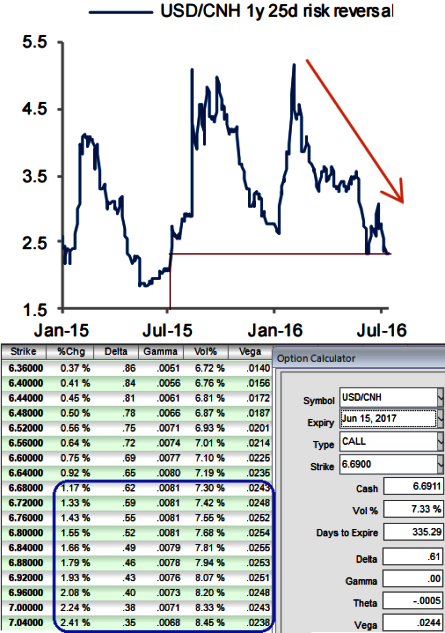
Risk reward profile: The 1y risk reversal is trading at a one-year low as shown in the diagram. It provides a good entry point to reload topside exposure despite the expensive volatility and also be noted that the healthy vega and gamma flashes on OTM call strikes. It also means that the vol market does not discount a disordered RMB depreciation, further supporting our short vega view.
Three-year-old depreciation trend reverses, the supply-demand imbalance in capital flows reaches equilibrium or hard-landing risks recede, causing the nearly three-year-old RMB depreciation cycle to reverse. The structure would face unlimited losses if USDCNH trades below the 6.55 strike in one year.
Vanilla calls or call spreads are too expensive when considering the probability-weighted terminal value of CNH a year from now. Under the premise that USDCNH only retraces a modest portion of the recent gains (similar to past experience when after an up move USDCNH did not revisit the lows and that there are no strong arguments for sustained appreciation on fundamental grounds, selling downside optionality can cheapen the cost of the call spread quite significantly.







