


 Fed May Resume Rate Hikes: BofA Analysts Outline Key Scenarios
  UBS Predicts Potential Fed Rate Cut Amid Strong US Economic Data
  China’s Growth Faces Structural Challenges Amid Doubts Over Data
  Lithium Market Poised for Recovery Amid Supply Cuts and Rising Demand
  Moody's Upgrades Argentina's Credit Rating Amid Economic Reforms
  Gold Prices Slide as Rate Cut Prospects Diminish; Copper Gains on China Stimulus Hopes
  US Gas Market Poised for Supercycle: Bernstein Analysts
  S&P 500 Relies on Tech for Growth in Q4 2024, Says Barclays
  Stock Futures Dip as Investors Await Key Payrolls Data
  Goldman Predicts 50% Odds of 10% U.S. Tariff on Copper by Q1 Close
  U.S. Treasury Yields Expected to Decline Amid Cooling Economic Pressures
  Wall Street Analysts Weigh in on Latest NFP Data
  Oil Prices Dip Slightly Amid Focus on Russian Sanctions and U.S. Inflation Data
  U.S. Banks Report Strong Q4 Profits Amid Investment Banking Surge
  Indonesia Surprises Markets with Interest Rate Cut Amid Currency Pressure
  UBS Projects Mixed Market Outlook for 2025 Amid Trump Policy Uncertainty
  Global Markets React to Strong U.S. Jobs Data and Rising Yields


Turkish GDP expanded 0.40% in the third quarter of 2019 over the previous quarter.
And the annual inflation rate increased to 10.56% in November 2019 from a near three-year low of 8.55% in the previous month, and slightly below market expectations of 11%.
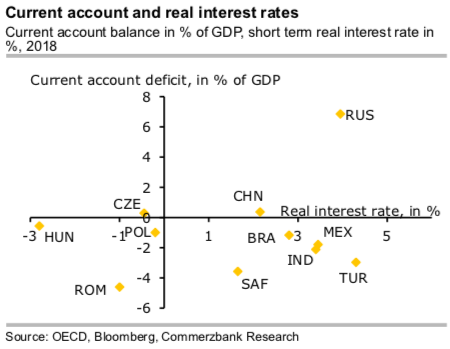
But their young demographics means that volume growth tends to do fine, at the cost of worsening underlying imbalances. The domestic saving rate is on the low side and cannot finance investment – the need to import foreign capital and a large current-account deficit are the consequences. The best counter against imbalances building up would be to maintain a high, positive real interest rate.
At present, this may not seem like a problem: The real interest rate appears high and the current-account deficit small (refer 1st chart). But this is only because the economy went through recession over the past year, which crushed import demand and brought inflation lower. These benefits are beginning to reverse: on a forward-looking basis, Turkey’s real interest rate is hardly positive while the trade deficit is going to get wider.
Yet, it is politically inconvenient to maintain a high real interest rate which would slow growth down. This brings us back full-circle to Turkey’s precarious situation with central bank independence, which darkens the lira outlook.
Hedging Strategy:
On hedging grounds, 2m USDTRY debit call spreads are advocated with a view to arrest upside risks. Initiated 2m 5.50/6.24 call spreads at net debit. One achieve hedging objective as the deep in the money call option with a very strong delta will move in tandem with the underlying spikes.
It seems that hedgers of TRY are positioned for the upside risks on the above fundamental factors. The positively skewed IVs of 2m tenors are bidding for OTM calls strikes up to 6.30 levels (refer 2nd chart).
IVs of this underlying pair is also on the higher side, trending highest among the G20 FX space. Call options with a higher IVs cost more, because, increasing IV is conducive for the option holder, just for an intuition that the higher likelihood of the market ‘swinging’ in holder’s favour. Courtesy: Sentry & JPM







