


 Trump Allegedly Sought Airport, Penn Station Renaming in Exchange for Hudson River Tunnel Funding
  Trump’s Inflation Claims Clash With Voters’ Cost-of-Living Reality
  Missouri Judge Dismisses Lawsuit Challenging Starbucks’ Diversity and Inclusion Policies
  U.S. Lawmakers to Review Unredacted Jeffrey Epstein DOJ Files Starting Monday
  Trump Endorses Japan’s Sanae Takaichi Ahead of Crucial Election Amid Market and China Tensions
  US Pushes Ukraine-Russia Peace Talks Before Summer Amid Escalating Attacks
  TrumpRx.gov Highlights GLP-1 Drug Discounts but Offers Limited Savings for Most Americans
  South Korea Assures U.S. on Trade Deal Commitments Amid Tariff Concerns
  Trump Signs “America First Arms Transfer Strategy” to Prioritize U.S. Weapons Sales
  Iran–U.S. Nuclear Talks in Oman Face Major Hurdles Amid Rising Regional Tensions
  Trump Signs Executive Order Threatening 25% Tariffs on Countries Trading With Iran
  Ohio Man Indicted for Alleged Threat Against Vice President JD Vance, Faces Additional Federal Charges
  Jack Lang Resigns as Head of Arab World Institute Amid Epstein Controversy
  Netanyahu to Meet Trump in Washington as Iran Nuclear Talks Intensify
  Trump Lifts 25% Tariff on Indian Goods in Strategic U.S.–India Trade and Energy Deal
  Trump Says “Very Good Talks” Underway on Russia-Ukraine War as Peace Efforts Continue


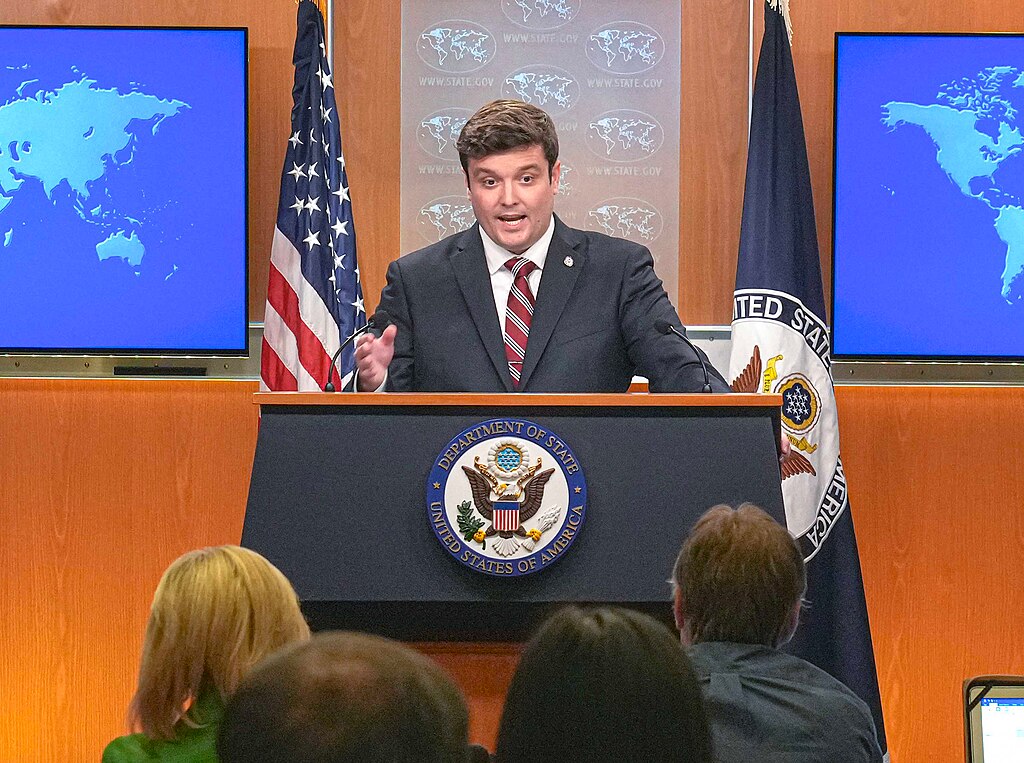
The United States has reaffirmed its commitment to defend the Philippines following a fresh clash between Chinese and Filipino vessels in the disputed South China Sea. The U.S. State Department on Monday strongly condemned Beijing’s “ramming and water cannoning” of a Philippine vessel near Sandy Cay in the Spratly Islands, a region that has become a flashpoint in regional maritime disputes.
State Department spokesperson Tommy Pigott emphasized that Washington “stands with its ally” as China’s actions continue to “undermine regional stability.” He reiterated that Article IV of the 1951 U.S.-Philippines Mutual Defense Treaty extends to “armed attacks on Philippine armed forces, public vessels, or aircraft—including those of its Coast Guard—anywhere in the South China Sea.”
The confrontation occurred after China’s Foreign Ministry urged Manila to stop what it described as “violations and provocations,” defending its operations as measures to “safeguard territorial sovereignty and maritime rights.” The Philippines, however, accused China of escalating tensions through aggressive tactics.
The South China Sea remains one of the world’s most critical trade routes, facilitating over $3 trillion in annual commerce. Despite international rulings rejecting China’s expansive claims, Beijing continues to assert control over most of the waterway, putting it at odds with several Southeast Asian nations.
The U.S. State Department reiterated that China’s “sweeping territorial and maritime claims” violate international law and commitments to peaceful dispute resolution. American officials have increasingly called for tangible steps to deter Chinese aggression. Last year, senior U.S. senators urged the Pentagon and State Department to develop concrete support measures for the Philippines, arguing that limiting the U.S. response to verbal assurances weakens the credibility of its defense commitments.
As tensions rise, Washington’s latest statement underscores its intent to maintain a strong military and diplomatic presence in the Indo-Pacific to ensure freedom of navigation and uphold international law.













