


 Japan’s Prime Minister Sanae Takaichi Secures Historic Election Win, Shaking Markets and Regional Politics
  Elon Musk’s Empire: SpaceX, Tesla, and xAI Merger Talks Spark Investor Debate
  China Warns US Arms Sales to Taiwan Could Disrupt Trump’s Planned Visit
  Nasdaq Proposes Fast-Track Rule to Accelerate Index Inclusion for Major New Listings
  Trump Says “Very Good Talks” Underway on Russia-Ukraine War as Peace Efforts Continue
  New York Legalizes Medical Aid in Dying for Terminally Ill Patients
  Bosnian Serb Presidential Rerun Confirms Victory for Dodik Ally Amid Allegations of Irregularities
  Netanyahu to Meet Trump in Washington as Iran Nuclear Talks Intensify
  Sydney Braces for Pro-Palestine Protests During Israeli President Isaac Herzog’s Visit
  India–U.S. Interim Trade Pact Cuts Auto Tariffs but Leaves Tesla Out
  Japan Election 2026: Sanae Takaichi Poised for Landslide Win Despite Record Snowfall



The rupiah’s movement is one key economic issue in this period leading to the April presidential and general elections.
The two presidential candidates, the incumbent President Joko ‘Jokowi’ Widodo and his rival, Prabowo Subianto, can capitalise on the issue in their campaigns.
In this article, I predict the rupiah will remain stable at this crucial time before and after the elections.
2018: a rough ride with a soft landing
The rupiah’s exchange rate was on a rough ride in the first half of 2018. In May 2018, the currency breached its psychological barrier of Rp14,000 per US dollar. The rupiah continued to be volatile and ended at beyond Rp15,000 per US dollar as of October.
This happened as Indonesia experienced lower-than-expected growth in its gross domestic product (GDP). During the time the US Federal Reserve (the Fed) had also aggressively raised interest rates, putting further pressure on the rupiah.
However, since November 2018, the rupiah has made an unexpected turn. The currency continued to fluctuate in an upward trend. By the end of December, it had bounced back to the level of Rp14,560 per US dollar.
There were several reasons for this strengthening. First, Indonesia’s government imposed a number of policies to help support the rupiah. One was the decision to increase import tax on selected goods to soften domestic demand for dollars. In addition, the reduced tension in the US-China trade war also contributed to the strengthening of the rupiah.
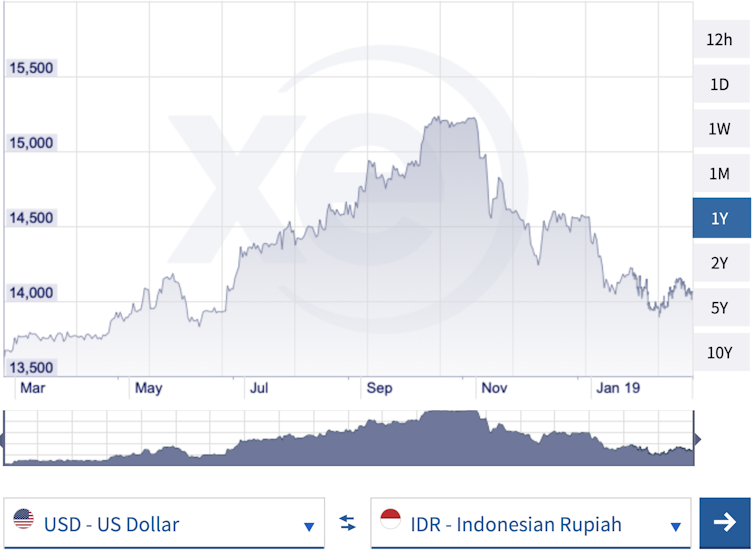
Source: www.xe.com.
Rupiah’s movement in 2019
The rupiah was off to a good start in the new year, trading at Rp14,120 per US dollar in mid-January.
Some analysts projected a possibility for the currency to continue gaining ground despite global uncertainty surrounding economic growth in the US and China.
By the end of January, the rupiah had returned to the rate of Rp14,000 per US dollar.
Indonesian Finance Minister Sri Mulyani commented that positive developments in the domestic economy made Indonesia more attractive for foreign investors compared to other emerging countries. She added that government tax revenue at the end of 2018 was much higher than around the same period in 2017.
All of these positive sentiments led to the appreciation of the rupiah.
How will the rupiah behave in the next two months?
I am fairly optimistic that the rupiah will remain stable at around Rp14,000 per US dollar in the near future. At least, there are three key reasons which would support this prediction.
First, Indonesia has had a long and good track record in staging successful and peaceful elections. I believe this election will not be any different. Stable political conditions will contribute to the stability of the rupiah’s exchange value.
Second, it is now less likely that the Fed will raise US interest rates as its economy no longer shows symptoms of an overheating economy.
Third, the central bank of Indonesia, Bank Indonesia, has reaffirmed its commitment to intervene through sales of foreign exchange reserves, when necessary, to maintain a favourable exchange rate.
Rupiah and the elections
It would be in the interests of the incumbent to have a relatively stable rupiah. A weakening of a currency is often perceived negatively as a sign of weak economy.
A stronger rupiah would also be advantageous for Indonesia’s government debt position. In particular, it will help Jokowi in responding to Prabowo’s arguments on the concerns over the increasing government debt.
All eyes in Indonesia will focus on the remaining presidential debates before the big election day. I certainly look forward to the fifth and last debate with great anticipation. This debate is scheduled to highlight key economic issues in Indonesia.













