


 Australia Inflation Cools as Core CPI Misses Forecasts, Easing RBA Rate Hike Pressure
  UK Budget Swings to Surprise £1.8 Billion Deficit in July
  BOJ Rate Decision in Focus as Sticky Inflation, Weak Yen Shape USD/JPY and Nikkei Outlook
  Citadel Warns High Treasury Yields Pose Broader Market Risks
  Singapore Central Bank’s Exchange Rate Policy Explained: Why MAS Uses the S$NEER Instead of Interest Rates
  Brazil Cuts Selic Rate to 14% as Inflation Eases but Risks Persist
  Oil Prices Ease as US-Iran Tensions Keep Brent on Track for Weekly Gain
  RBA Signals More Rate Hikes Possible as Australia Battles Stubborn Inflation
  Japan Services Producer Prices Rise 3.2% in June, Supporting BOJ Rate Hike Expectations
  Trump Says Iran Talks Halted as Strait of Hormuz Dispute Fuels Oil Concerns


 Add as a preferred source on Google
Eurostat, the EU’s statistics agency, released Eurozone inflation data for the month of June earlier today. Official figures show that inflation across the 19-country eurozone fell to its lowest level this year on easing energy prices. Data highlighted the European Central Bank's struggles to boost consumer prices since it first resorted to extraordinary measures by taking one of its key interest rates into negative territory in June 2014.
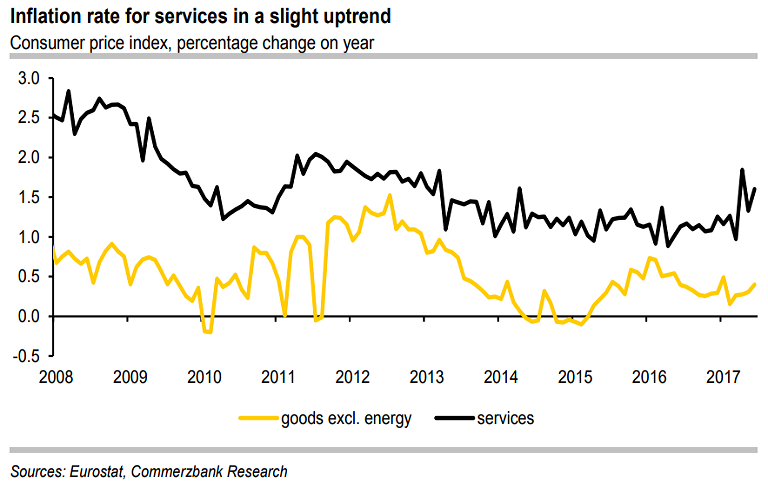
The eurozone’s annual rate of inflation fell for the second straight month in June to 1.3 percent in the year to June, down from 1.4 percent the month before. The core rate of inflation, which is the year-on-year rate of the consumer price index excluding energy, food, alcohol and tobacco – rose more than expected, by 0.2 percentage points to 1.1 percent. Inflation rate for services jumped from 1.3 percent to 1.6 percent.
The fall was largely attributable to a waning impact from higher energy prices, which were up only 1.9 percent from the year before against 4.5 percent in the previous month. The annual rate of inflation was slightly higher than anticipated, but the fall edged the annual rate further away from the ECB's target of just below 2 percent.
"We still assume that the core rate of inflation will only exceed 1% sustainably in 2018. This argues against an imminent ECB rate hike, especially with inflation expectations likely to remain low in view of the progressive decline of the headline rate of inflation to 1.3%," said Commerzbank in a report.
The ECB has recently upgraded its GDP projections as well as its risk assessment. But on the other side the central bank remains very cautious when it comes to inflation development. ECB president Mario Draghi has shown strong confidence on the monetary policy efficiency in his speech earlier this week.
Draghi said that the decline in interest rates has triggered a solid economic growth, deflationary pressures has disappeared and should gradually be replaced by reflationary forces. At the same time the speech also underlined the need to be persistent and prudent given, in particular, the real extent of labour market underutilization, suggesting that inflation should gradually pick up but it could take more time than currently forecast.
At 1100GMT, EUR/USD was trading at 1.1406, down 0.28 percent on the day. At the same time FxWirePro's Hourly Euro Strength Index stood neutral at -1.22995. For more details, visit http://www.fxwirepro.com/currencyindex.
FxWirePro launches Absolute Return Managed Program. For more details, visit http://www.fxwirepro.com/invest







