


 Anthropic Nears $15 Billion Credit Deal Ahead of IPO
  SpaceX Turbine Push Unlikely to Threaten Howmet, Bernstein Says
  Adobe Names Anil Chakravarthy CEO as AI Push Accelerates
  J.P. Morgan Upgrades Diploma, Lifts Price Target to 8,250p
  OpenAI Launches GPT-6 Astra With Advanced AI Agent Capabilities
  China is launching a Moon mission to find water ice. It’s unlike anything NASA has done
  JPMorgan Sees ECB Raising Rates to 2.75% in December
  Want to muck around with a real quantum computer? Now you can
  Faraday Future Delivers First Robots in Middle East, Plans September Launches


 Add as a preferred source on Google
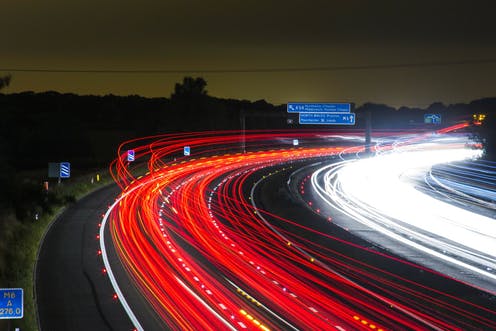

A government minister recently suggested that the UK should raise its motorway speed limit for cars and vans to 80mph as a way of increasing national productivity. It’s a perennial political idea that has already been proposed and then ruled out by the government at least once in the past decade. Despite claims that the current 70mph limit is embedded in the national psyche, 48% of car drivers choose not to comply with it.
But, aside from the question of whether being able to get to meetings faster would really impact national productivity, would raising the motorway speed limit even make that much of a different to journey times?
The main problem with this idea is that persistent congestion often prevents people from travelling at the existing speed limit. A former chief executive of the Highways Agency suggested we should even expect peak time motorway speeds as low as 40mph on some routes. Another problem is phantom traffic jams, which usually occur when drivers are travelling too fast in comparison to the traffic around them. If one driver rapidly brakes, the driver behind them will have to do the same and so on until a whole line of traffic is forced to stop.
The way the UK has primarily tried to tackle the issue of congestion in recent years is not by building more roads but by introducing so-called smart motorways. These use electronic signs to change the speed limit depending on the flow of traffic. Ironically, by keeping drivers travelling slower, smart motorways can help prevent phantom traffic jams and ensure everyone gets to their destination faster.
This technology can also be used to allow even higher speeds when there are fewer cars on a road. In the Netherlands, smart motorways have been introduced in combination with an increase in the motorway speed limit from 120km/h (75mph) to 130km/h (81mph). But drivers travelling during peak times tend not to benefit from the higher limit because congestion causes the smart motorway to reduce the speeds, so any potential productivity boost is limited.
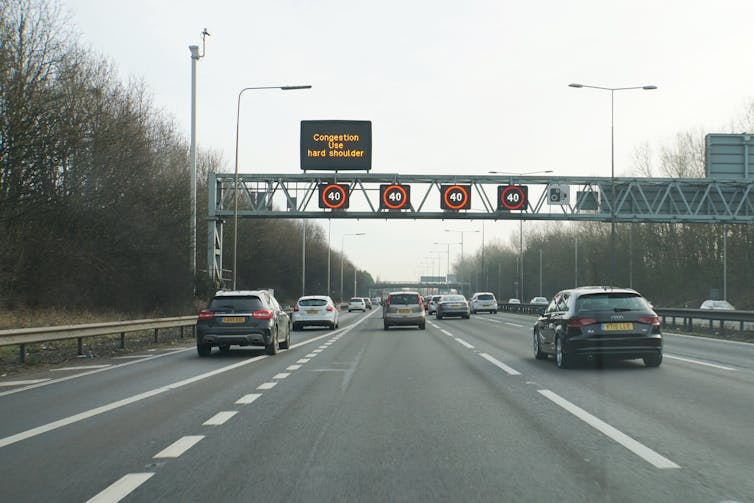
Smart motorways can reduce the speed limit to manage congestion. Bill Boaden, CC BY-SA
One argument for increasing the speed limit is that it – and most roads – were designed for a different generation of vehicles. Every road has a design speed, defined as the rate at which 85% of drivers choose to travel in free flow conditions. Design speeds in current UK standards range from 50km/h (31mph) to 120km/h (75mph) depending on the type of road. A road’s design speed isn’t necessarily the same thing as the legal speed limit.
The road is then built to ensure that it can be used safely at this design speed. This includes ensuring curves aren’t so sharp that vehicles slide off the road, and that drivers can see far enough ahead to stop safely in an emergency. This means any vehicles that go faster than the design speed are at a higher risk of collision.
Many argue that these design parameters are based on historical designs and that modern vehicles have more effective brakes and handling. If this is true, it would mean existing road design standards are conservative and the risks of driving faster than the design speed have been reduced. A wide-ranging review of the standards, including a look at changes to vehicle design, is to be completed by 2020 and may lead to updates in the way roads are built.
But even if today’s vehicles can safely drive faster than our roads’ design speed, 95% of all road crashes have human error as a factor. Most of us are simply not the good drivers we think we are. The recent launch of a national campaign highlighting the failure of drivers on England’s roads to keep a safe distance illustrates this point only too well. Higher speeds gives us less time to respond and react to a critical situation.
As such, it’s perhaps unsurprising that a recent OECD study across ten countries has found that increasing road speed, including on motorways, consistently leads to a disproportionate increase in the number and severity of crashes. And more crashes leads to more congestion and longer journey times.
Best case scenario
But putting all this aside and assuming you were able to continuously drive safely on the motorway at the speed limit, how much time would a 10mph increase typically save you? Despite carrying large volumes of traffic in a relatively safe manner when compared with other routes, motorways comprise just a small proportion of the UK road network. The start and end of any trip tend to be on local roads in urban areas, inevitably forming the slowest part of any journey, and this would not benefit from the change in the speed limit.
Government statistics show that 88% of trips on motorways are less than 50 miles in length. Assuming it were possible to drive continuously at 80mph instead of 70mph, the time saving on such a journey would be only five minutes at the very most.
So all things considered, on a good day, increasing the motorway speed limit would save the majority of motorists just enough time to make a cup of tea. Whether drinking tea will boost national productivity is a matter for an entirely separate debate.







