


 DWF Labs Sues BitGo for $114 Million Over Alleged Token Sales Breach
  Solana Targets 200ms Block Time in Major Network Upgrade
  Dogecoin Liquidations Surge as DOGE Bulls Face Heavy Losses
  Ledger Investigates Alleged $86 Million Crypto Wallet Theft
  GRAM Price Jumps 9% as Telegram Expands Money Wallet
  Stellar Overtakes Ethereum in RWA Fund Inflows as XRP Leads Commodities
  Bitcoin Rebounds to $82K as Crypto Market Faces Weekly Losses
  Jameson Lopp Downplays AI Threat to Bitcoin Cryptography
  Zcash Plans Quantum-Resistant Security Upgrade for January
  MSTR Stock Rises as Barclays Raises Price Target to $175
  Chainlink Price Drops 3% Despite New CCIP Vault Launch
  David Schwartz to Reveal XRP Ledger Future at Ripple Swell 2026
  XRP Ledger Activates New Security Feature for Banks and Stablecoins


 Add as a preferred source on Google
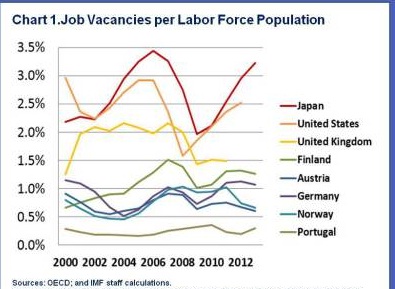
The chart from IMF reveals Europe's chronic problem, especially for the countries in Euro Zone. The chart shows job vacancies per labor force population. While the ratio remains high for Japan (+3%), US (+2.5%), for Euro zone countries it is just around 1% or below.
Euro zone really needs to improve its employment scenario by creating more jobs.
European Central Bank (ECB) is already pushing record easing by purchasing about €60 billion per month of asset purchase in a bid to boost inflation.
But the last thing Euro zone need is Asset price inflation thanks to easy monetary policies, what is required is demand driven inflation, which can hardly be achieved without maximum employment. Current ECB mandate doesn't include employment but it is expected to ease financial condition such that to boost growth and employment.
However, while loose monetary policy is keeping the conditions in place for employment and growth improvement, it clearly needs support of fiscal policy. Politicians in Europe, needs to go beyond poll friendly shorter term policies to growth and employment driven longer ones.
Unless Euro zone's tight labor market loosens Euro zone unlikely to realize its true potential.
With unemplyement hovering around 11%, it may not be wise to expect social stability.







