


 Dollar Hits Two-Month High as Fed Rate Hike Bets Rise
  Asian Currencies Muted as Dollar Firms Ahead of Trump-Xi Summit
  RBI Uses $10 Billion Currency Swaps to Drain Excess Rupee Liquidity
  Gold Prices Rise as Oil Slide Eases Fed Rate Hike Fears
  Russian Envoy Dmitriev Heads to US for Ukraine Talks
  Oil Prices Rise as U.S.-Iran Talks Fuel Diplomacy Hopes
  Gold Prices Rise as Oil Slump Eases Fed Rate Hike Fears
  RBA Says ASX Still Falls Short on Governance and Risk Controls


 Add as a preferred source on Google
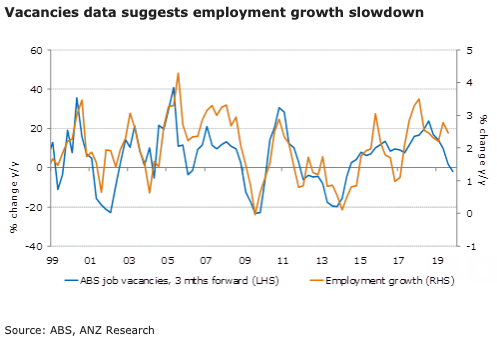
Australian job vacancies fell by 1.9 percent q/q in the August 2019 quarter, bringing annual growth down to -1.9 percent y/y, the first y/y decline since 2014. The decline was concentrated in private sector vacancies, as public sector vacancies continue to grow, ANZ Research reported.
Falling vacancies in the last six months represent a convergence with job ads and other leading indicator data, which have been soft for some time.
Weakness was concentrated in the major knowledge sectors. Professional services fell 12.6 percent q/q and 13.5 percent y/y (the weakest result since 2014) and education fell 7.1 percent q/q and 9.6 percent y/y (the sharpest annual decline in education vacancies in 5 years).
Continuing weakness in construction vacancies (-5.1 percent q/q after -18.7 percent q/q to May) and a sharp decline in health (-8.1 percent q/q) also contributed to the decline.
New South Wales vacancies fell, in annual terms, for the first time in five years (-7.5 percent y/y), while Victoria recorded its second consecutive annual fall (-9.2 percent y/y). All other states/territories experienced vacancy growth, except South Australia.
Meanwhile, falling vacancies in the last six months represents a convergence with job advertisement data, which have been weakening for some time. Weakness in both leading indicators is a strong signal that employment growth could slow in the near term. This is concerning because unemployment has been rising despite strong employment growth in recent months, the report further noted.







