


 Fed Unveils Stablecoin Rules Under GENIUS Act
  US 10-Year Treasury Yield at 6% Emerges as New Market Risk Threshold
  Asian Stocks Fall as Surging Bond Yields Rattle Markets
  Oil Prices Jump 3% as Houthi Attack Revives Supply Fears
  Best Gold Stocks to Buy Now: AABB, GOLD, GDX


 Add as a preferred source on Google
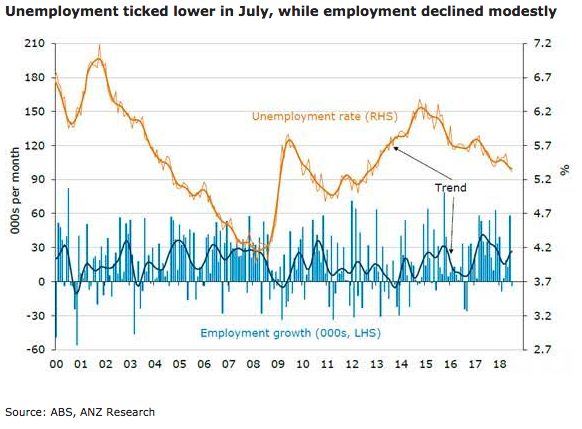
Australia’s unemployment rate, edged down again and at 5.3 percent is at a six-year low, alongside a decline in the participation rate from 65.7 percent to 65.5 percent. Leading indicators for the labour market are slightly more mixed than they have been, but continue to point to ongoing improvement in the near term, according to the latest report from ANZ Research.
Employment fell 3.9k in July, following an upwardly revised 58.2k jump in June. The weakness was driven by part-time jobs which fell 23.2k, while full-time jobs were up 19.3K after the 43.2k rise in June.
Across the country, in a reversal of last month’s trends, NSW was the weakest with employment down sharply (-27.1), while Victoria was the strongest (+29.4K). Elsewhere, there were small falls in WA (-3.0K) and Qld (-1.9K), while the other states and territories saw modest rises.
"Overall though they continue to point to ongoing gradual improvement in the labour market in the near term, with a further decline in the unemployment rate. Ongoing improvement in the labour market is critical to the outlook for wages growth and the eventual return of inflation to the mid-point of the RBA’s 2–3 percent target band," the report added.







