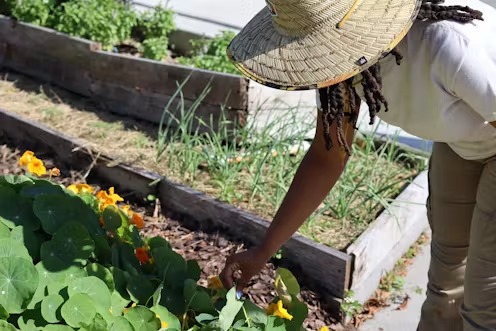
Urban agriculture is expected to be an important feature of 21st century sustainability and can have many benefits for communities and cities, including providing fresh produce in neighborhoods with few other options.
Among those benefits, growing food in backyards, community gardens or urban farms can shrink the distance fruits and vegetables have to travel between producers and consumers – what’s known as the “food mile” problem. With transportation’s greenhouse gas emissions eliminated, it’s a small leap to assume that urban agriculture is a simple climate solution.
But is urban agriculture really as climate-friendly as many people think?
Our team of researchers partnered with individual gardeners, community garden volunteers and urban farm managers at 73 sites across five countries in North America and Europe to test this assumption.
We found that urban agriculture, while it has many community benefits, isn’t always better for the climate than conventional agriculture over the life cycle, even with transportation factored in. In fact, on average, the urban agriculture sites we studied were six times more carbon intensive per serving of fruit or vegetables than conventional farming.
However, we also found several practices that stood out for how effectively they can make fruits and vegetables grown in cities more climate-friendly.
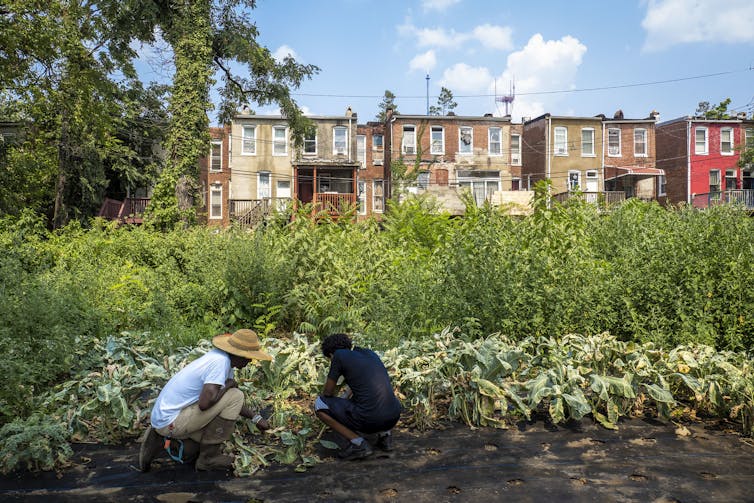
Community gardens like Baltimore’s Plantation Park Heights Urban Farm provide a wide range of benefits to the community, including providing fresh produce in areas with few places to buy fresh fruits and vegetables and having a positive impact on young people’s lives. Preston Keres/USDA/FPAC
What makes urban ag more carbon-intensive?
Most research on urban agriculture has focused on a single type of urban farming, often high-tech projects, such as aquaponic tanks, rooftop greenhouses or vertical farms. Electricity consumption often means the food grown in these high-tech environments has a big carbon footprint.
We looked instead at the life cycle emissions of more common low-tech urban agriculture – the kind found in urban backyards, vacant lots and urban farms.
Our study, published Jan. 22, 2024, modeled carbon emissions from farming activities like watering and fertilizing crops and from building and maintaining the farms. Surprisingly, from a life cycle emissions perspective, the most common source at these sites turned out to be infrastructure. From raised beds to sheds and concrete pathways, this gardening infrastructure means more carbon emissions per serving of produce than the average wide-open fields on conventional farms.
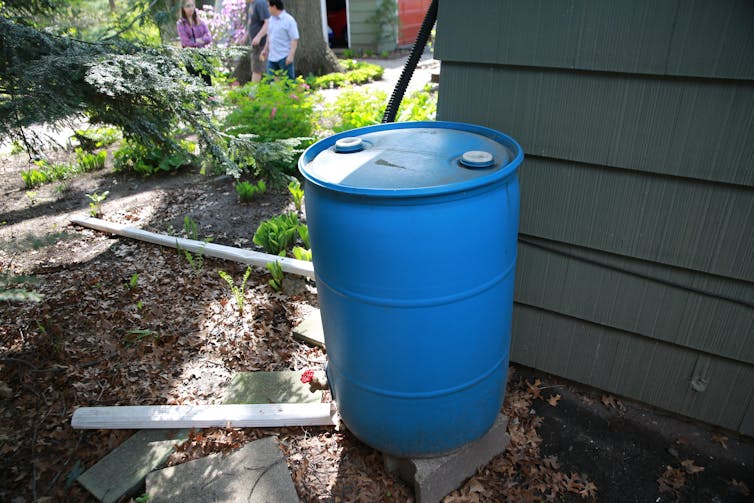
Capturing rainwater from gutters to feed gardens can cut the need for fresh water supplies. Water pumping, treatment and transportation in pipes all require energy use. Minnesota Pollution Control Agency, CC BY-NC-SA
However, among the 73 sites in cities including New York, London and Paris, 17 had lower emissions than conventional farms. By exploring what set these sites apart, we identified some best practices for shrinking the carbon footprint of urban food production.
1) Make use of recycled materials, including food waste and water
Using old building materials for constructing farm infrastructure, such as raised beds, can cut out the climate impacts of new lumber, cement and glass, among other materials. We found that upcycling building materials could cut a site’s emissions 50% or more.
On average, our sites used compost to replace 95% of synthetic nutrients. Using food waste as compost can avoid both the methane emissions from food scraps buried in landfills and the need for synthetic fertilizers made from fossil fuels. We found that careful compost management could cut greenhouse gas emissions by nearly 40%.
Capturing rainwater or using greywater from shower drains or sinks can reduce the need for pumping water, water treatment and water distribution. Yet we found that few sites used those techniques for most of their water.
2) Grow crops that are carbon-intensive when grown by conventional methods
Tomatoes are a great example of crops that can cut emissions when grown with low-tech urban agriculture. Commercially, they are often grown in large-scale greenhouses that can be particularly energy-intensive. Asparagus and other produce that must be transported by airplane because they spoil quickly are another example with a large carbon footprint.
By growing these crops instead of buying them in stores, low-tech urban growers can reduce their net carbon impact.
3) Keep urban gardens going long term
Cities are constantly changing, and community gardens can be vulnerable to development pressures. But if urban agriculture sites can remain in place for many years, they can avoid the need for new infrastructure and keep providing other benefits to their communities.
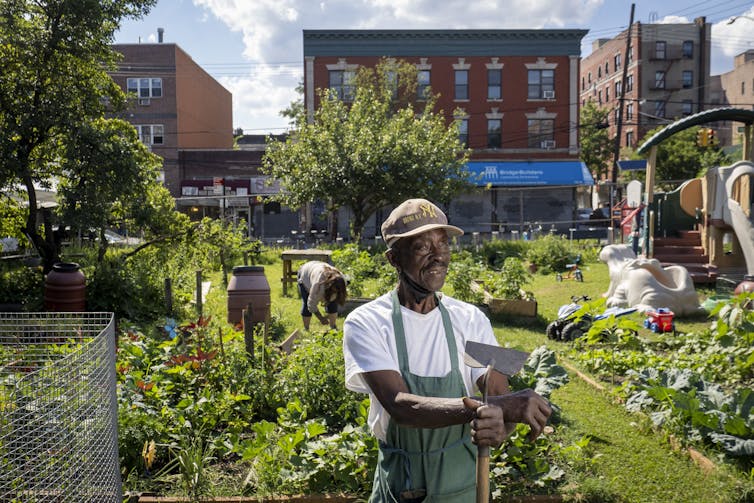
Taqwa Community Farm in the Bronx, New York, has provided space to grow fresh vegetables for the community for over three decades. The farm composts food waste to create its own natural fertilizer, reducing its costs and climate impact. Preston Keres/USDA/FPAC
Urban agriculture sites provide ecosystem services and social benefits, such as fresh produce, community building and education. Urban farms also create homes for bees and urban wildlife, while offering some protection from the urban heat island effect.
The practice of growing food in cities is expected to continue expanding in the coming years, and many cities are looking to it as a key tool for climate adaptation and environmental justice.
We believe that with careful site design and improved land use policy, urban farmers and gardeners can boost their benefit both to people nearby and the planet as a whole.