


 Saudi Arabia Raises Security Alerts as Houthi Attacks Threaten Oil Routes
  Asian Stocks Rise as Investors Brace for Fed Rate Decision
  Gold Prices Slip as Fed Rate Hike Looms, Treasury Yields Rise
  China Industrial Output Beats Forecasts as Exports Support Growth
  Dollar Rises as Fed Hike Bets Weigh on Asian Currencies
  UK Wage Growth Slows as BoE Rate Decision Looms
  Finland Raises 2026 Growth Forecast as Exports and Investment Surge
  Goldman Sachs Forecasts Fed Rate Hike as Inflation Risks Rise
  Oil Prices Surge as Houthi Attacks Raise Saudi Supply Fears
  Gold Prices Steady as Oil Disruptions Boost Fed Rate Hike Bets
  German 2-Year Yield Hits 2023 High as Rate Hike Bets Rise
  US Stocks Rise Ahead of Fed Rate Decision
  Gold Prices Fall as Hot U.S. Inflation Boosts Fed Rate Hike Bets
  Vietnam, U.S. Firms Plan 29 Deals Across Energy, Tech and Aviation
  China’s Slower Loan Growth Becomes ‘New Normal’ as Credit Demand Weakens
  Hormuz Vessel Traffic Drops to Single Digits
  BOJ Flags Import Costs and Yen Shocks as Persistent Inflation Risks


 Add as a preferred source on Google



At the end of last year, the world’s average price to emit one tonne of greenhouse gases was around US$5.29 (AU$7.77). For pricing to work as we want – to wean us off fossil fuels – it needs to be around $75 by the end of the decade, according to the International Monetary Fund.
Why is the price still so low? Because even in 2023, close to 80% of the world’s emissions from land clearing, power plants, cars and industry are pumped into the atmosphere without any cost to the polluter.
Carbon prices have long been favoured by economists and experts as a way to drive faster change. If you want to discourage something, the easiest way is to make it cost more. Pricing the three main greenhouse gases – carbon dioxide, methane and nitrous oxide – is an elegant and effective way to force polluters to find alternative ways of producing power or creating forms of transport. (Carbon price refers to pricing a tonne of carbon dioxide equivalent, CO₂-e, which covers all three gases).
There’s long been a strange disconnect between the minute-by-minute updates on financial asset prices and the the lack of information on carbon prices. In 2023, as extreme weather, droughts and floods propel climate change to the front of our minds, it’s far easier to access streams of data on share markets, commodities, foreign exchange than it is to find data on the measure most critical to global survival – the price of carbon. That’s why our research team worked to produce the first global carbon price index as a way to easily track changes in pricing globally – and see change over time.
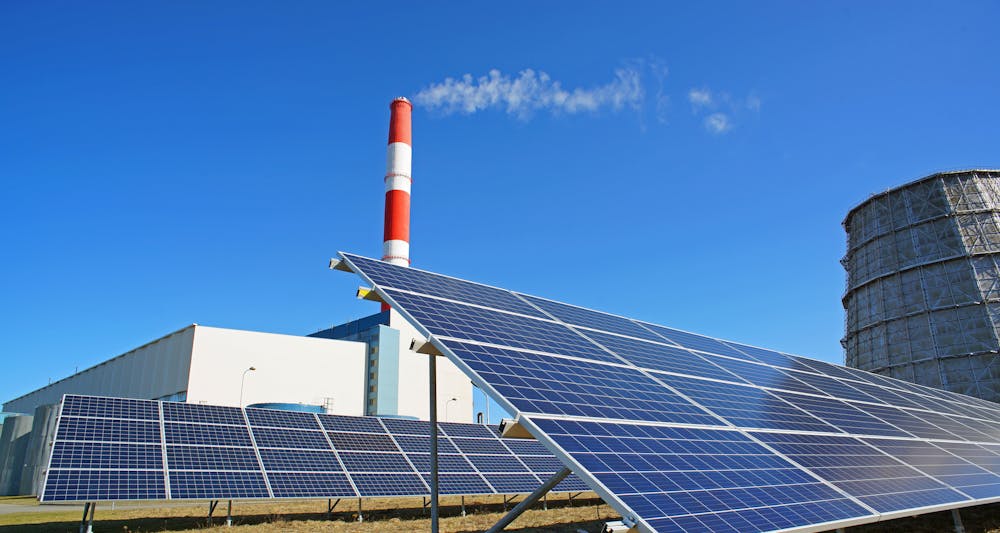
Carbon pricing can help us go from fossil fuels to clean electricity. Shutterstock
How did we determine the true price of carbon?
To nail down the global price of carbon, we took into account every national or supranational scheme as well as the price of carbon traded through emissions trading schemes. We did not use carbon credits or offsets, as these tend to lack transparency, be rubbery and often questionable.
Different countries and jurisdictions have come at the problem of atmospheric pollution from different directions.
The simplest is to simply tax the pollutants you don’t want. This works if the price is set at the right level – not too low or too high at first – and increased as necessary.
Another common approach is to create a market for pollution through an emissions trading scheme, where high emitters have to purchase allowances. Over time, the new market will set the price on polluting as emitters and others compete for this finite pool of allowances. Regulators progressively cut the number of allowances, driving up the price of each allowance. The end result is to nudge large polluters to cut more and more of their emissions.
We didn’t include carbon credits or offsets in our indices, as their use is largely voluntary, they tend to be unregulated or loosely regulated, their supply is uncapped, and their impact varies widely. Whistleblowers have claimed Australia’s main carbon offset scheme is largely useless, for instance.
So what changes have we seen?
We first calculated this index a decade ago, when it became possible to pull together reliable price and scope information. When the index began, the global carbon price was just $0.67 per tonne of CO₂-e (or carbon dioxide equivalents). Back in 2013, only 20 jurisdictions had a price on carbon, covering just 8% of global emissions. At the time, Australia was one of them, before the so-called “climate wars” took over national politics.
Over the last decade, however, we’ve seen significant progress. The current price of around $7.77 per tonne of CO₂-e is almost eight times higher than 2013. From 20 countries or jurisdictions, we now have 58, accounting for 22.5% of global emissions. That includes the European Union’s emission trading scheme and China’s new national scheme, which respectively account for around 3% and 9% of emissions globally. The schemes don’t cover their whole economies.
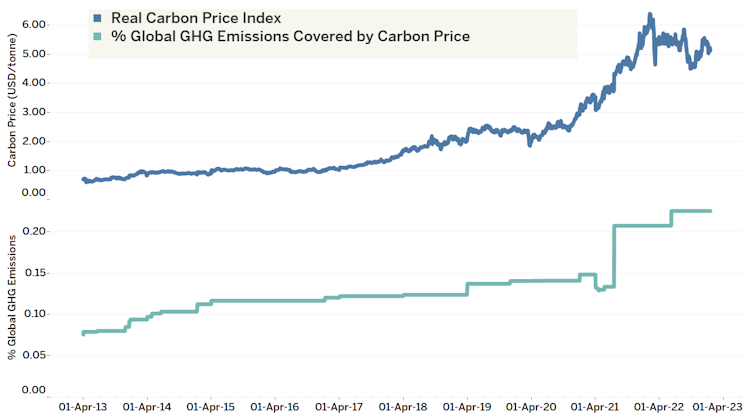
This chart shows the evolution of the carbon price index since 2013.
That’s the good news. The bad news is there’s still a way to go. More than three-quarters of emissions go unpriced – costing the polluter nothing. That’s why the global carbon price is still so low. Nations like India, Iran, Russia, Indonesia and Australia have no carbon price or trading scheme.
Australia still bringing up the rear
Australia’s domestic emissions account for 1.27% of global greenhouse gas emissions. When you include our staggering fossil fuel exports as the world’s top LNG exporter and major coal exporter, our impact on the world climate almost quadruples to 5%. That’s depressingly high, given our population is just 0.3% of the world’s total.
Despite our vastly outsized carbon footprint, Australia still doesn’t have a mandated carbon price. We do have a safeguard mechanism – a baseline above which its big polluters need to pay. At present, the baseline is too high, meaning only a small number of polluters participate. The mechanism is currently under review.
Until the baselines are set lower and penalties enforced, Australia will remain a laggard in the fight against climate change. Labor’s pledge to cut emissions 43% by 2030 came without mention of a price on carbon.
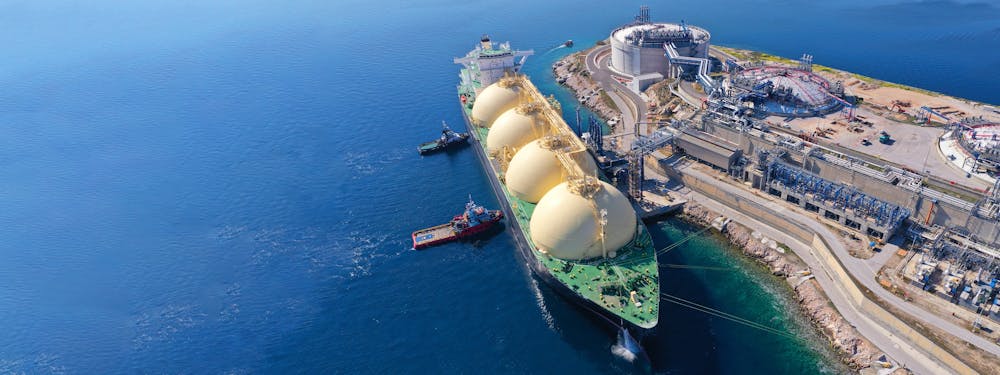
Australia’s gas and coal exports vastly increase our broader emissions impact. Shutterstock
Will the rest of the world embrace carbon pricing?
Political pushback killed Australia’s first effort at pricing carbon in 2012. Similarly, political gridlock in America has made carbon pricing a non-starter at the national level. In response, left of centre governments have turned to different approaches, such as spending heavily on newly cheap clean energy.
Does this mean we’ll never see the global carbon price hit the point where it will be effective? It’s hard to say, but at present, it seems unlikely every major nation will price carbon.
That doesn’t mean it’s a waste of time for the nations and jurisdictions like the European Union which are embracing it. Far from it. It’s well established we can drive behaviour change by measuring it against a benchmark or expectation. That’s where we hope the real carbon price index can play a role. After all, this is one of the numbers that really matters.
Almost all of the trillion tonnes of carbon dioxide we’ve emitted since the Industrial Revolution were emitted for “free”. As global heating intensifies, the true cost is becoming ever more apparent.







