


 BOJ Rate Hike Expectations Rise as Weak Yen and Strong U.S. Jobs Data Increase Pressure
  Japan Signals Preference for Low Interest Rates as BOJ Policy Debate Intensifies
  ECB Set to Raise Interest Rates as Energy Shock Fuels Eurozone Inflation Concerns
  ECB Keeps July Rate Options Open Amid Iran War Energy Price Risks
  Mary Daly Says AI Uncertainty Clouds Fed Rate Outlook Despite Restrictive Policy
  South Korea Signals Possible Interest Rate Hike as Inflation Remains Elevated
  Best Gold Stocks to Buy Now: AABB, GOLD, GDX
  FxWirePro: Daily Commodity Tracker - 21st March, 2022


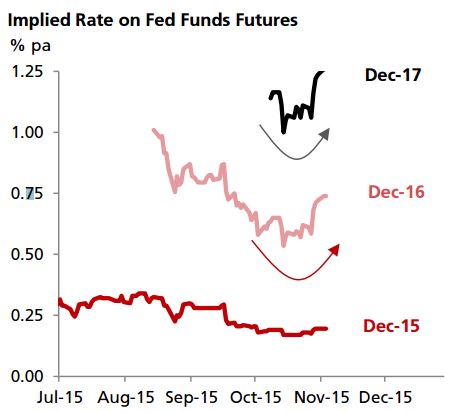
Over the past two weeks, market expectations of Fed normalization have rebounded somewhat. Much of this has got to do with the market interpreting the October FOMC outcome to be more hawkish than anticipated. Sensitivity to changing expectations is more apparent for end-2016 and end-2017 as compared to the end-2015. Notably, the implied Fed funds rate for end-2015 barely bounced by 3bps from the low in October to 0.2%. Comparatively, the adjustments for end-2016 and end-2017 were larger at 20bps and 26bps respectively.
While these implied rates are still well down from levels seen in mid-September, the market seems to be warming up to the possibility of Fed normalization over the medium term even if liftoff does not take place this year. Meanwhile, longer-term USD rates also rose amid an improvement in risk sentiment. Part of this has also got to do with an increase in oil prices over the past week.
On balance, we think USD rates are biased higher over the medium term as Fed normalization occurs. However, we remain cognizant that this is a binary affair. Global growth risks lurk with market rates still pricing in a fair chance of stagnation.







