


 Asian Stocks Rise as Softer U.S. Inflation Boosts Sentiment Despite Middle East Tensions
  FxWirePro: Daily Commodity Tracker - 21st March, 2022
  US Stock Futures Fall as Netflix Outlook, Chip Selloff and Iran Tensions Weigh on Markets
  Asian Stocks Slide as Chip Selloff Deepens Ahead of TSMC Earnings
  UBS Boosts China Tech Bets, Adds Kuaishou and Meituan to Focus List
  Brazil Weighs IP Curbs, Patent Suspensions After New U.S. Tariffs
  Asian Currencies Stay Rangebound as Middle East Tensions, Weak China GDP Weigh on Sentiment
  US Inflation Expected to Ease in June, but Fed Rate Hike Risks Persist Amid Middle East Tensions
  Dollar Slides as Softer US Inflation Dims Fed Rate Hike Expectations
  Gold Prices Fall Amid Rate Jitters; Copper Steady as China Stimulus Eyed


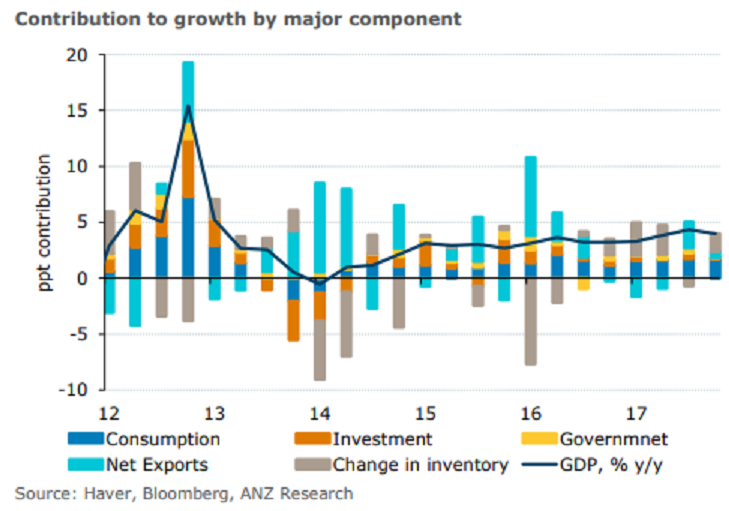
Thailand’s full-year gross domestic product (GDP) for 2018 is expected to come in at 3.7 percent y/y, with investment activity picking up only gradually during the year. Further, government infrastructure spending is expected to eventually start crowding in private investment, albeit in a gradual manner, according to a recent report from ANZ Research.
Thailand’s Q4 GDP increased by 0.5 percent q/q in seasonally adjusted terms, translating into an annual growth of 4.0 percent y/y. For full-year 2017, growth came in at 3.9 percent. Notwithstanding the full year growth number, there is scope for improvement in the breadth of growth. Growth remains predominantly supported by exports with private investment unable to gain traction through the year.
In Q4 2017, both private and public consumption also disappointed on a sequential basis, although this is likely to have been a one-off development. Until growth gains further breadth, the Bank of Thailand (BoT) is unlikely to start normalizing monetary policy.
The moderation in q/q growth was mainly on account of weakness in private and public consumption. The two components declined 1.4 percent q/q and 3.0 percent q/q respectively, even though the y/y growth for both was positive due to a favorable base. The contraction in these two components is likely to have been temporary.
"With this backdrop, the risk of a sustained increase in inflation remains low. While the BoT expects headline CPI to move into the target range of 1-4 percent in Q2, we believe it will settle close to the lower bound of this target range," the report added.
Lastly, FxWirePro has launched Absolute Return Managed Program. For more details, visit http://www.fxwirepro.com/invest







