


 Gold Prices Drop as Fed Rate Outlook and Iran Tensions Weigh on Market
  US Stock Futures Steady as Investors Await Payrolls Data and Monitor Iran Tensions
  Trump Suspends Some Morocco Fertilizer Tariffs to Ease U.S. Supply Shortage
  Dollar Slips Ahead of Key U.S. Jobs Data as Fed Rate Outlook, ECB, and Iran Talks Shape Forex Markets
  RBA Minutes Signal Australia Central Bank Remains Ready to Raise Interest Rates if Inflation Persists
  Central Banks Eye Gold, Reduce Dollar Exposure as AI Adoption Accelerates: OMFIF Survey
  Oil Prices Rise as US-Iran Tensions Threaten Strait of Hormuz Oil Shipments
  Gold Price Hits Annual Low as Fed Rate Hike Bets and Sticky Inflation Weigh on Bullion
  Yen Falls to 40-Year Low as Markets Watch Japan Intervention and U.S. Jobs Report
  Trump Threatens 100% Tariffs on Countries Imposing Digital Services Taxes on U.S. Tech Firms
  Wall Street Futures Rise Ahead of JOLTS Data, Nike Earnings, and U.S.-Iran Talks
  World Bank Approves $1.1 Billion Emergency Funding for Bangladesh Amid Food and Energy Price Pressures
  China Expands Export Controls, Adds 20 Japanese Companies to Restricted List
  Argentina Economy Shrinks 1.5% in April, Recovery Under Milei Loses Momentum
  China Manufacturing PMI Edges Higher in June as Exports and AI Investment Boost Growth
  Japan Targets 1%+ Real Economic Growth With ¥370 Trillion Investment Plan


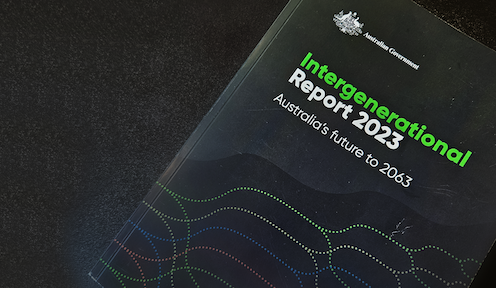

The Australian government has just released the latest iteration of its Intergenerational Report, the sixth since the first was published in 2002.
Each provides a snapshot of the sort of Australia in which future generations will find themselves in 40 years’ time, should current government policies continue.
Previous reports have dealt mainly with the impact of an older age profile on government budgets and our way of life. This one also made space for the impact of climate change.
1. Increasing optimism about ageing
The good news for future budgets in this report is that, although Australia’s population will still age rapidly, it is expected to age more slowly than previously thought.
The chart below shows the projections in each of the six reports for the proportion of the population aged 65 and over.
In 2002, the first intergenerational report predicted that by 2023 the share of the population aged 65 and over would have climbed from 12.5% to nearly 19%, and then would rise to 24.5% by 2042.
Yet, in the intervening years, Australia saw an unanticipated migration boom, which slowed that rate of ageing so that today only 17.3% of the population is aged 65 and over, and the projection for 2063 is 23.4%, less than the 24.5% originally expected for 2042.
These updated projections suggest that by 2063 Australia’s population will be younger than that of Italy now, or Japan a decade ago.
And ageing will slow further if net migration climbs higher than the 235,000 per year assumed in the latest report. A more reasonable migration assumption might be that it will in fact increase alongside increases in the total population.
2. Increased optimism about willing workers
The projections for labour force participation (the proportion of the adult population who are either working or making themselves available for work) have become more optimistic with each intergenerational report.
While participation is still expected to drop, the latest projection is for more of a glide than a dive, leaving participation higher in 2063 than it was in 2002.
As the report puts it, participation is projected to decline from a record high of 66.6% in 2023 to 63.8% by 2063.
The gentle slope of the decline reflects offsetting forces. More of us will be older and less able to work, but within most age groups, more of us will be in work.
3. Increased optimism about the cost of the pension
More optimistic demographic projections and sensible policy choices have resulted in less extreme increases in age-related spending.
Spending on pensions is projected to fall rather than climb as a share of the economy, falling from 2.3% to 2% of GDP. This is by design.
While in other countries pensions are more generous and increase with earnings, in Australia the age pension is more modest and reduces with means.
By pairing the age pension with superannuation, which increases people’s means in retirement, pension spending falls.
By the 2060s, pension spending in Australia will be less than half the rate of the next lowest-spending OECD country (though admittedly that comparison ignores tax expenditures on super).
4. Increased optimism about spending on health
Government spending on health as a proportion of GDP is still projected to increase, from 4.6% now to 6.2% in 2063, but is expected to remain well short of the first intergenerational report’s projection of more than 8% by 2042.
Only 40% of this projected increase in health spending is due to ageing, which ought not to be the least bit surprising.
As people and societies grow richer and satisfy more of their basic needs, they naturally want to spend more of what they have on extending their lives and improving their health, demanding more and better healthcare from government.
5. Increased pessimism about the cost of aged care
Spending on aged care is set to grow more than many other types of spending, albeit from a low base.
The Intergenerational Report has it doubling from 1.1% of GDP in to 2.5% in 2063.
The projection may well be an underestimate. Governments are yet to fully respond to demands for greater quality of care set out in the report of the royal commission into aged care quality and safety.
6. Increased pessimism about living standards
When it comes to resources for meeting the needs we need to meet, the Nobel prizewinning economist Paul Krugman famously noted in 1994 that productivity wasn’t everything, but in the long run it was “almost everything”.
Productivity growth, and assumptions about future productivity growth, have continued to decline with almost every intergenerational report.
The assumption for long-term productivity growth in this report is 1.2%, down from 1.75% in the 2002 intergenerational report.
The difference this makes is enormous. The 2002 intergenerational report had living standards (GDP per person) climbing 90% in 40 years. This latest intergenerational report has them climbing only 57% in the next 40 years.
7. A deteriorating Commonwealth budget
While slower ageing means this report predicts the government’s future budget deficits will be lower than those projected in all previous reports bar one, the budget is expected to be in a deepening deficit for much of the next 40 years.
Naturally, this can be fixed with more tax, but the projected lower rate of productivity growth means there will be relatively less to tax than was expected in the first intergenerational report in 2002.
Launching the report at the National Press Club, Treasurer Jim Chalmers talked about the need for action now on multiple fronts, saying there would “never be a quiet time to think about the future”.
But on raising more tax he was silent, suggesting it was a question for the future.







