


 RBI Uses $10 Billion Currency Swaps to Drain Excess Rupee Liquidity
  US Dollar Near 18-Month High Ahead of Inflation Data
  IMF, World Bank Meetings Face Global Economic Risks Amid Iran War
  RBI Rate Hike Bets Surge as Inflation Rises
  Philippines Current Account Deficit Seen at $19.1 Billion in 2026
  RBA Set for September Rate Hike as Inflation Stays High
  European Auto Stocks Rise as EU-China Trade Deal Targets Hybrid Imports
  Hong Kong’s Second Solana ETF Launches With Lower Fees
  ECB May Stop Rate Hikes After December, Capital Economics Says
  Fed Minutes Signal Another Rate Hike by Year-End
  Ripple-Backed Evernorth Set for Nasdaq Debut With 473 Million XRP
  BOJ Signals Faster Rate Hikes as Inflation Risks Grow


 Add as a preferred source on Google
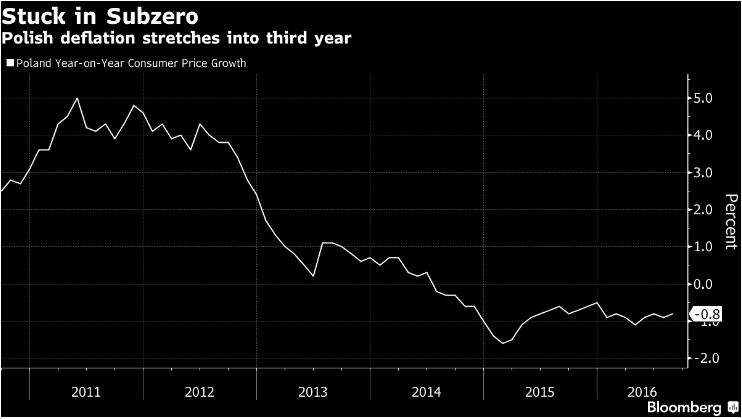
Polish 10-member Monetary Policy Council left the seven-day reference rate at 1.5 percent Wednesday largely in line with expectations. The central bank, which ended an easing cycle in March last year, also kept its lombard rate flat at 2.50 percent, the deposit rate at 0.50 percent and the rediscount rate at 1.75 percent.
In a statement that followed, Governor Adam Glapinski said after the decision that the bank is “moving closer to an interest-rate increase,” he said he “hopes” that will happen in the latter stages of 2017, once the economy accelerates, deflation ends and price growth starts to approach the 2.5 percent inflation target.
Although the Polish inflation remains distinctively negative, the Monetary Policy Committee did not change the monetary policy settings because the European Union’s biggest eastern economy has expanded by at least 3 percent every quarter for the past two years. Since the previous rate meeting in July, Poland's statistics office said consumer prices fell 0.8 percent in annual terms in August. The central bank's inflation target is 2.5 percent.
Poland's economic growth missed forecasts last quarter, expanded 3.1 percent y/y in Q2. Governor Adam Glapinski attributed the slower-than-predicted pace to delays in tapping EU funds and said it was “good and stable” and should pick up in the first half of next year. The central bank forecasts an expansion of 3.1 percent to 3.3 percent in 2016, compared with the 3.6 percent he forecast in July.
Poland suffered its biggest fall in investment for almost four years in the second quarter, however, data showed at the end of August, as political uncertainty discouraged firms from spending at a time of reduced aid from the European Union. Glapinski said Poland could move out of deflation and instead see a low rate of inflation at the end of this year or early next year while economic growth would accelerate next year due to more EU funds flowing in.
“Accelerating inflation and a quite high probability that it will return near the target in a few quarters may prompt policy makers to raise rates in the second half of 2017,” said Jakub Borowski, chief economist at Credit Agricole SA in Warsaw.
EUR/PLN extended downside for the fourth consecutive session today. The pair was trading at 4.3136 at around 08:30 GMT. Technicals point to further downside. We see scope for test of 4.25 levels in the coming weeks.







