


 Ukraine Faces $56 Billion Budget Gap as War Costs Soar
  Trump Gaza Peace Plan Stalls as Israel Retains Control
  Flavio Bolsonaro Surges as Family Scores Brazil Election Comeback
  Trump Plans Diesel Tax Relief as Fuel Prices Hit Record Highs
  New York Declares Measles Disaster Emergency as Cases Surge
  Becton Dickinson to Invest $3 Billion in U.S. Medical Manufacturing
  France Student Protests Intensify Nationwide
  US Caribbean Vessel Strike Kills Four
  Trump Envoy Meets Sudan Army Chief in Egypt
  Trump Orders Firing Squad Execution for Fort Hood Gunman
  US DOT Ends Airline Privacy Review Without Enforcement
  India-US Trade Deal Talks Hit Plateau, Sitharaman Says
  US Army Tests Counter-Drone Technology Along Mexico Border
  Flavio Bolsonaro, Lula Head to Brazil Presidential Runoff
  Yemen Launches Major Offensive to Retake Houthi-Held Areas
  Ethiopia-Tigray Fighting Intensifies as Airstrikes Kill 17
  Australia Probes Flydubai Co-Pilot’s Links After FZ1073 Hijack Attempt


 Add as a preferred source on Google
Japanese Prime Minister Fumio Kishida spoke with French President Emmanuel Macron on the sidelines of the G20 Summit in Bali. Kishida told Macron that he hopes Japan and France could strengthen cooperation in the Indo-Pacific region.
The Japanese foreign ministry issued a statement on Kishida’s meeting with Macron Tuesday. Kishida told Macron that he hopes the two countries could strengthen their cooperation in ensuring a free and open Indo-Pacific. Both leaders also discussed the ongoing war in Ukraine, China’s growing influence in the region, climate change, and energy.
This follows Kishida’s remarks during the East Asia Summit over the weekend that China’s activities in the region are increasingly breaching Japan’s sovereignty. Kishida stressed that ensuring peace and stability in the Taiwan Strait was key to security in the region. Kishida also expressed his concern over the alleged treatment of the Uyghur minority in China’s Xinjiang province.
“There has been continued, increasing actions by China in the East China Sea that violates Japan’s sovereignty. China also continues to take actions that heighten regional tension in the South China Sea,” Kishida told his counterparts at the meeting, according to a statement by the ministry.
Kishida echoed the comments by US President Joe Biden, stressing the importance of peace in the Taiwan Strait and ensuring freedom of navigation in the contested South China Sea.
China claims to have sovereignty over the majority of the South China Sea and the Taiwan Strait, angering surrounding nations. China also claims to have sovereignty over a part of the East China Sea.
Kishida also expressed concern over the multiple missile tests conducted by North Korea this year, saying that the tests posed a “clear and serious challenge” against the international community.
Kishida was also in attendance at the ASEAN Summit along with the United States and told reporters Sunday that the two allies agreed on the need to “strengthen the deterrent strength of the US-Japan alliance amid mounting challenges to the security of the region.”
“We reaffirmed that unilateral attempts to change forcefully the status quo is unacceptable, and confirmed that Russia’s threats with nuclear power cannot be tolerated,” said Kishida.
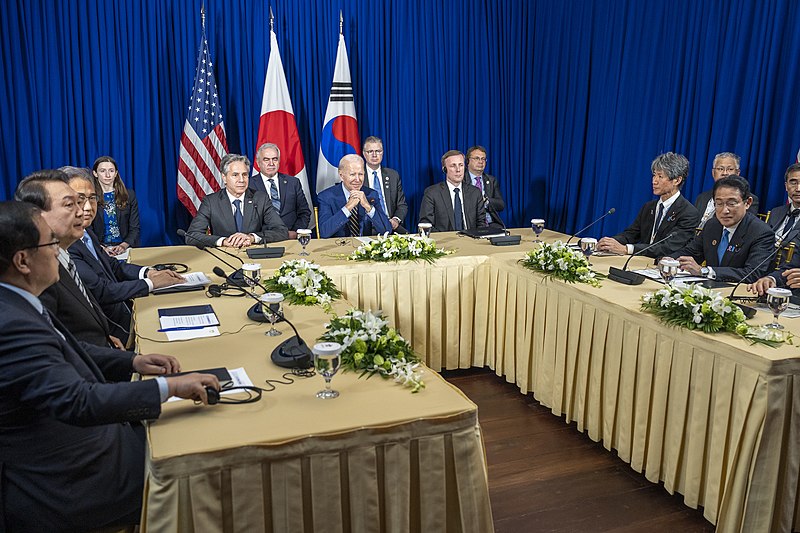
Kishida and Biden also held a trilateral summit with South Korean President Yoon Suk-yeol to discuss the threat posed by North Korea and its missile launches.







