


 Asian Stocks Slide as Nikkei Leads Losses on Tech Selloff and Rising U.S.-Iran Tensions
  U.S. Imposes 25% Tariff on Select Brazilian Imports After Section 301 Trade Investigation
  Gold Prices Head for Biggest Weekly Loss Since June as Fed Rate Outlook Weighs
  Asian Stocks Slide as Chip Selloff Deepens Ahead of TSMC Earnings
  Asian Stocks Rise as Softer U.S. Inflation Boosts Sentiment Despite Middle East Tensions
  South Korea Raises Interest Rates to 2.75% as Inflation and Weak Won Drive Tightening
  China Q2 2026 GDP Misses Forecast as Weak Domestic Demand Offsets Export Strength
  Brazil Weighs IP Curbs, Patent Suspensions After New U.S. Tariffs
  Oil Prices Climb as Trump Escalates Iran Pressure, Strait of Hormuz Risks Grow
  Oil Prices Rise as U.S. Strikes on Iran Raise Strait of Hormuz Supply Fears


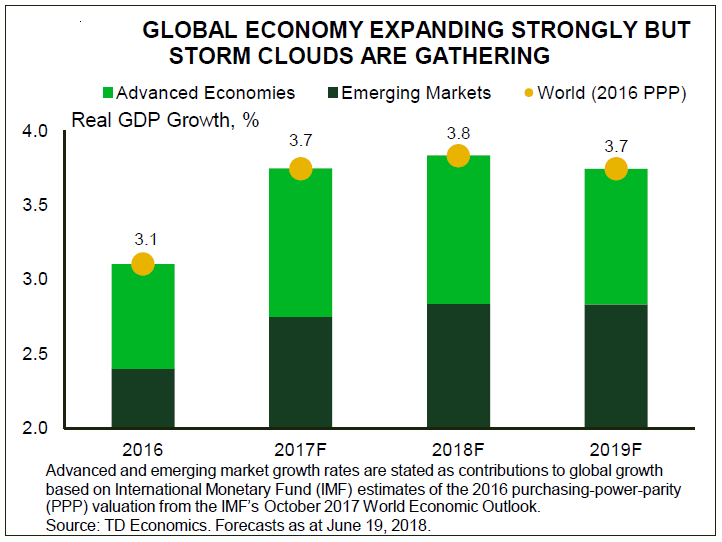
Global growth is expected to run at a robust 3.8 percent this year, similar to last year. However, this steady performance hides a weaker-than-expected start in the Euro Area and the UK, which can be partly chalked up to temporary factors, according to a recent research report from TD Economics.
Fortunately, a recovery from the first quarter stumble appears underway, with both regions expected to benefit from moderately above-trend growth over the next couple of years. It’s already becoming clear that the real standout performer for 2018 is going to be the U.S., which is tracking a 3.0 percent pace. The U.S. is widening its lead on other G7 economies this year, leading to less synchronous growth among the major economies relative to 2017.
Price pressures have also been building unevenly, with core inflation measures already near the central bank targets for the U.S. and Canada. In contrast, underlying wage and price pressures in Europe, the UK, and Japan remain relatively subdued, providing little incentive for a knee-jerk removal of past emergency stimulus.
Further the U.S. dollar rally in the past few months is a reflection of this divergence theme. This may become more difficult to sustain among the G7 currencies, as second quarter economic data offers investors more confidence. However, emerging markets remain vulnerable, as U.S. assets will remain more attractive from a risk-reward standpoint, the report added.
Within Europe, much of the slowdown earlier this year can be chalked up to weakness in France and the UK. Over the next two years, an average projection of about 2 percent for real GDP happens to land right in between last year’s solid 2.6 percent advance and the Euro Area’s long-run trend rate of about 1.3 percent.
"This means economic slack will continue to diminish, even if it’s at a slower pace than previously expected. This is why the central bank has gained confidence in telegraphing plans to commence a long-awaited tapering of its asset purchase program this year," the report commented.
At this point, G7 central banks are choosing to look-through the near-term challenges to the outlook for growth and inflation. As a result, we anticipate that the Federal Reserve is on track to push its policy rate higher in September, and Canada is likely to proceed with raising rates in July, a final time for 2018. Overseas, the Bank of England has become more patient, as unexpected economic weakness and gradually falling inflation has stayed its hand at least until this August.







