


 US Futures Rise as Investors Eye Earnings, Inflation Data, and Wildfire Impacts
  2025 Market Outlook: Key January Events to Watch
  J.P. Morgan Sees Potential Vestas Guidance Upgrade Amid Strong Wind Energy Demand
  China’s Growth Faces Structural Challenges Amid Doubts Over Data
  U.S. Stocks vs. Bonds: Are Diverging Valuations Signaling a Shift?
  Energy Sector Outlook 2025: AI's Role and Market Dynamics
  Gold Prices Slide as Rate Cut Prospects Diminish; Copper Gains on China Stimulus Hopes
  How Donald Trump has changed the way diplomacy is done
  Sell the Bounce": Gold Rally Stalls Near $4165 as Fed Hawks Slam the Door on Rate Cuts — Targets $4000/$3600
  Gold Prices Fall Amid Rate Jitters; Copper Steady as China Stimulus Eyed
  Bank of America Posts Strong Q4 2024 Results, Shares Rise


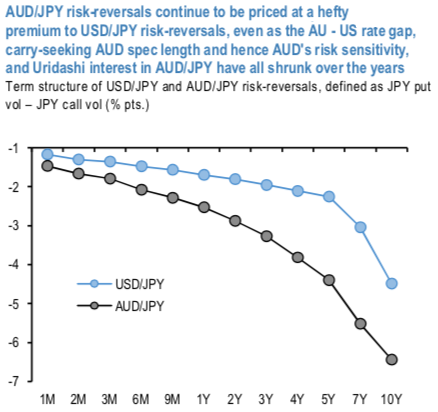
The richness of Yen risk-reversals has been a consistent feature of the FX option landscape and our commentary on the same in recent months, including in Outlook 2020 where fading the extended risk-reversal vs. ATM vol set-up was flagged a durable theta-earning theme over the year. The argument in favor of skew-selling is two-fold:
1) implied spot-vol correlation priced into risk-reversals is still rich despite some correction from 3Q’19 wides, since realized spot-vol correlation continues to be pressured by persistent unhedged Japanese outflows that have dampened the Yen’s traditionally acute (inverse) risk sensitivity; and
2) shorting skews takes the other side of relatively price- insensitive Japanese corporate and institutional hedging of US investments via risk-reversals rather than forwards over the past 12-18 months, the rationale for which has become considerably weaker over time as the US – Japan rate gap has narrowed and Yen skews have richened.
Our current trade expression to take advantage of this vol surface dislocation is a delta-hedged long ATM vs. short 25D 3M 1*1.5 ratio USDJPY put spread that intends to scalp smile theta with low/no outright vega exposure.
AUDJPY risk-reversals continue to be priced at a sizeable premium to USDJPY across expiries, most notably in longer maturities (2Y - 10Y, refer above chart). AUDJPY 5Y riskies for instance trade at a 0.8v premium (for JPY calls) over the arithmetic sum of 5Y AUDUSD and USDJPY riskies, which is not an unusual historical occurrence by any stretch but nonetheless suggests a lingering fear of GFC-like non-linearity / discontinuity in the behavior of the underlying spot. We are not convinced that this premium is justified for a number of reasons:
First, from a volatility perspective, AUD has become a pale shadow of the über-risk sensitive asset it once was as structural economic changes – in particular, the end of the Australian mining boom and its effects on debt-servicing capacity of strained household balance sheets – have ushered in idiosyncratic economic weakness and loosened AUD’s link to the global cycle. RBA’s counter-cyclical response to the growth slowdown of taking the cash rate down to all-time lows and thereby eliminating the traditionally high and positive AU - US yield gap has reinforced the decline in AUD’s risk beta, as carry-seeking speculative long positions have not only disappeared but in fact flipped short in anticipation secular economic weakness. The result is that GFC era boom-bust cycles of re-and de-leveraging of AUD longs are now history, and it is no longer unimaginable that bouts of risk-aversion could one day squeeze AUD higher should the initial condition going into such shocks be a large stock of short AUD positions. Courtesy: JPM







