


 J.P. Morgan Sees Potential Vestas Guidance Upgrade Amid Strong Wind Energy Demand
  Moldova Criticizes Russia Amid Transdniestria Energy Crisis
  Wall Street Analysts Weigh in on Latest NFP Data
  With Iran and the US signing a peace deal, where does that leave Benjamin Netanyahu?
  China’s AI Manufacturing Boom Masks Weak Consumer Economy, Citi Says
  Sell the Bounce": Gold Rally Stalls Near $4165 as Fed Hawks Slam the Door on Rate Cuts — Targets $4000/$3600
  SpaceX Stock Gets $175 Target as Analysts See Massive Growth Ahead
  Mexico's Undervalued Equity Market Offers Long-Term Investment Potential
  Stock Futures Dip as Investors Await Key Payrolls Data
  US Gas Market Poised for Supercycle: Bernstein Analysts
  U.S. Banks Report Strong Q4 Profits Amid Investment Banking Surge
  S&P 500 Relies on Tech for Growth in Q4 2024, Says Barclays
  Lithium Market Poised for Recovery Amid Supply Cuts and Rising Demand


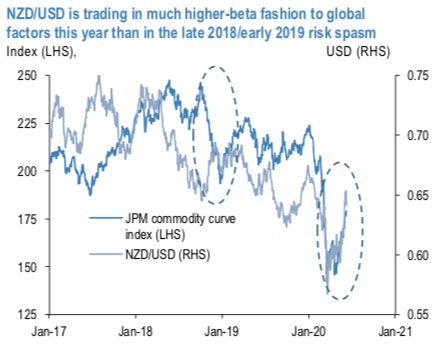
We have been bearish NZDUSD, owing to idiosyncratic growth challenges, and a dovish central bank. The RBNZ’s priorities are quite clear. They want a weaker exchange rate and have greater than average risk tolerance in getting it.
Mid-May’s burst of RBNZ dovishness was followed by a pretty much uninterrupted 8% rally in NZDUSD. In reality though, this bullish turn is less of a direct challenge to the RBNZ’s rhetoric than it is maintenance of the very high correlation to global risk markets that
NZD has demonstrated all year (refer above chart).
The medium-term perspectives: Risk sentiment is expected to remain firm into year-end, supported by unprecedented global central bank and government stimulus. In addition, NZ’s economic rebound has been slightly stronger than previously expected. All that should help NZDUSD end the year at around 0.65 levels. In the interim, there remains potential for a pullback to 0.61 on bouts of risk aversion, for example if the recent phase of positive NZ data surprises flips to data disappointments.
OTC Updates and Hedging Strategies:
Let’s now quickly glance through OTC updates before deep diving into the strategic frameworks of NZDUSD. The pair is showing moderated IVs among G10 FX bloc (3m IVs are in between 10.04 – 11.67%).
IV factor is highly imperative in FX option dynamics because the option pricing significantly depends on future volatility, and it is quite impossible for any veteran to ascertain accurate future volatility.
The skewness of 3m IVs still signals extreme downside risks, bids for OTM put strikes are quite visible (up to 0.6250 for these tenors, refer 2nd chart). Based on above-mentioned fundamental factors and OTC outlook, diagonal debit put spreads are advocated, the strategy is designed to mitigate the downside risks with a reduced cost of trading.
The execution: Short 1m (1.5%) OTM put option with positive theta (position seems good even if the underlying spot goes either sideways or spikes mildly), simultaneously, add long in 2 lots of delta long in 3m (1%) ITM -0.79 delta put options capitalizing on the minor upswings in the short-run.
Alternatively, we recommend short hedges staying shorts in NZDUSD futures contracts of July’20 delivery with a view of arresting bearish risks in the major trend. Courtesy: Sentry & JPM







