


 Gold Prices Fall Amid Rate Jitters; Copper Steady as China Stimulus Eyed
  China's Refining Industry Faces Major Shakeup Amid Challenges
  China’s AI Manufacturing Boom Masks Weak Consumer Economy, Citi Says
  Moody's Upgrades Argentina's Credit Rating Amid Economic Reforms
  Goldman Predicts 50% Odds of 10% U.S. Tariff on Copper by Q1 Close
  Stock Futures Dip as Investors Await Key Payrolls Data
  Urban studies: Doing research when every city is different
  AI Memory Boom Sparks Global Chip Supply Crunch
  Geopolitical Shocks That Could Reshape Financial Markets in 2025
  Today’s space race could turn fatal if we don’t agree on new rules
  How AI prompting turned writerly description into an everyday skill


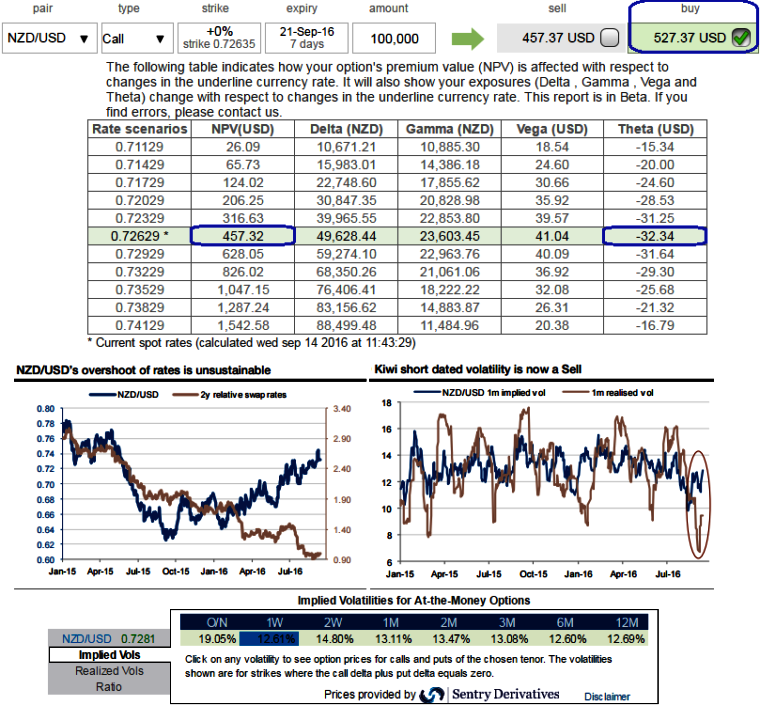
1w implied volatilities are flashing at 12.61%, while ATM calls of this time frame are priced at 15.38% more than Net Present Value. Hence, these call options are deemed as overpriced in prevailing bearish environment.
Expensive implied volatility and spot within a channel Implied volatility is elevated compared to realised volatility (see above graph), suggesting a structure selling it.
The downside skew is not sufficiently elevated to finance a put via low strikes (a put spread-like structure), but the negative skew is enough to obtain an attractive discount via a downside knock-out.
Such a barrier is appropriate for trading moderate NZDUSD downside, keeping in mind that the spot has been trapped within a bullish channel since the start of the year and that 0.70 is below the support line.
NZDUSD’s appreciation has occurred against the direction of interest rate differentials for months, and the disconnection recently widened with the latest bout of currency strength (see above Graph).
Hence, we think call writing could also be beneficial as IV skewness is conducive for prevailing bearish environment.







