


 RBA Says ASX Still Falls Short on Governance and Risk Controls
  Lithium Market Poised for Recovery Amid Supply Cuts and Rising Demand
  RBI Raises Repo Rate to 5.50% in Hawkish Shift on Inflation Risks
  S&P 500 Relies on Tech for Growth in Q4 2024, Says Barclays
  RBA Hikes Interest Rate to 4.60% as Inflation Risks Rise
  UBS Predicts Potential Fed Rate Cut Amid Strong US Economic Data
  Trump’s "Shock and Awe" Agenda: Executive Orders from Day One
  Oil Prices Dip Slightly Amid Focus on Russian Sanctions and U.S. Inflation Data
  U.S. Banks Report Strong Q4 Profits Amid Investment Banking Surge
  Fed's Hammack Urges Faster Rate Hikes to Fight Inflation
  European Stocks Rally on Chinese Growth and Mining Merger Speculation
  China’s Growth Faces Structural Challenges Amid Doubts Over Data
  Energy Sector Outlook 2025: AI's Role and Market Dynamics


 Add as a preferred source on Google
The new Mexican President will be elected on 1st July. At present, the polls predict a clear victory for Andrés Manuel López Obrador. The leftist-populist is certainly not the favourite as far as the financial markets are concerned, nor would his election make the NAFTA negotiations any easier. However, it remains to be seen how his plans will actually be implemented – election campaign rhetoric is often populist, whereas their implementation is often more pragmatic.
That Andrés Manuel López Obrador will win the presidential election should largely be priced into the exchange rate. The big question now is whether the Left Alliance Morena can win the majority in the Senate. Should the president no longer be limited by an opposition-dominated Senate, nervousness over excessive spending by the new government could mount in the financial markets.
In this case, the peso could come under devaluation pressure. At least AMLO's ideas of the important NAFTA negotiations do not differ noticeably from Mexico’s current position.
Whether or not a breakthrough can be achieved in the NAFTA negotiations, however, is not solely in Mexico’s power. All in all, the Mexican central bank (Banxico) has already pre-empted "election risk" affecting the MXN at its meeting last week: with a rate hike of 25 basis points to 7.75%. Should the uncertainty persist, it will further raise policy rates.
After the election, we expect MXN strength to continue as the environment rewards high-carry currencies with reduced uncertainty. We recommend hedging MXN exposures in the short-term but expect renewed foreign interest in 2H’18.
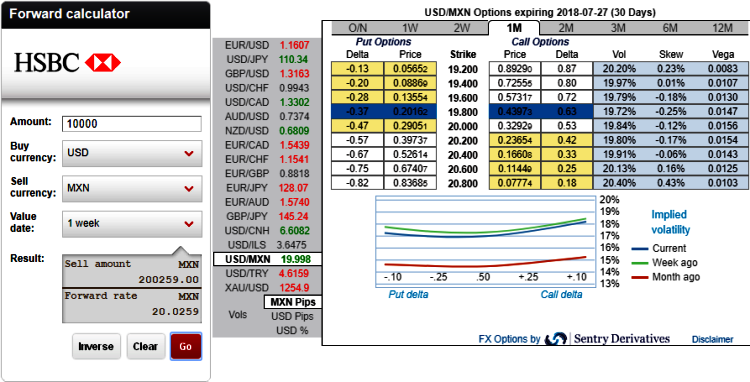
At the current market juncture, USDMXN 1M FVAs mid with the start date set to Q2 end are priced more than 8 vols below the January cycle high and come at a modest 1.3X ATM vols implying a good value in owning election vol to hedge the residual election risk. With overnight pricing commanding a punchy bid/offer, the equivalent pre-/post-calendar spreads (selling pre-event options and buying post-event options in order to isolate and capture sharp spot moves/realized volatility) are worth considering.
Please be noted that the 1m IV skews are stretched on either side that indicates both bullish and bearish risks on the cards. Thus, we recommend buying 12-week USDMXN ATMF straddles @19.75/16.25 financed by selling 8-week straddles. Courtesy: Commerzbank, JPM
Currency Strength Index: FxWirePro's hourly USD spot index is inching towards 166 levels (which is bullish) while articulating (at 13:56 GMT). For more details on the index, please refer below weblink:
http://www.fxwirepro.com/currencyindex
FxWirePro launches Absolute Return Managed Program. For more details, visit:







