


 RBA Expected to Raise Interest Rates by 25 Basis Points in February, ANZ Forecast Says
  Fed May Resume Rate Hikes: BofA Analysts Outline Key Scenarios
  S&P 500 Relies on Tech for Growth in Q4 2024, Says Barclays
  European Stocks Rally on Chinese Growth and Mining Merger Speculation
  US Gas Market Poised for Supercycle: Bernstein Analysts
  2025 Market Outlook: Key January Events to Watch
  MAS Holds Monetary Policy Steady as Strong Growth Raises Inflation Risks
  U.S. Stocks vs. Bonds: Are Diverging Valuations Signaling a Shift?
  Moody's Upgrades Argentina's Credit Rating Amid Economic Reforms
  Energy Sector Outlook 2025: AI's Role and Market Dynamics
  Gold Prices Slide as Rate Cut Prospects Diminish; Copper Gains on China Stimulus Hopes
  RBA Raises Interest Rates by 25 Basis Points as Inflation Pressures Persist
  ECB’s Cipollone Backs Digital Euro as Europe Pushes for Payment System Independence
  China's Refining Industry Faces Major Shakeup Amid Challenges
  Jerome Powell Attends Supreme Court Hearing on Trump Effort to Fire Fed Governor, Calling It Historic
  BOJ Rate Decision in Focus as Yen Weakness and Inflation Shape Market Outlook


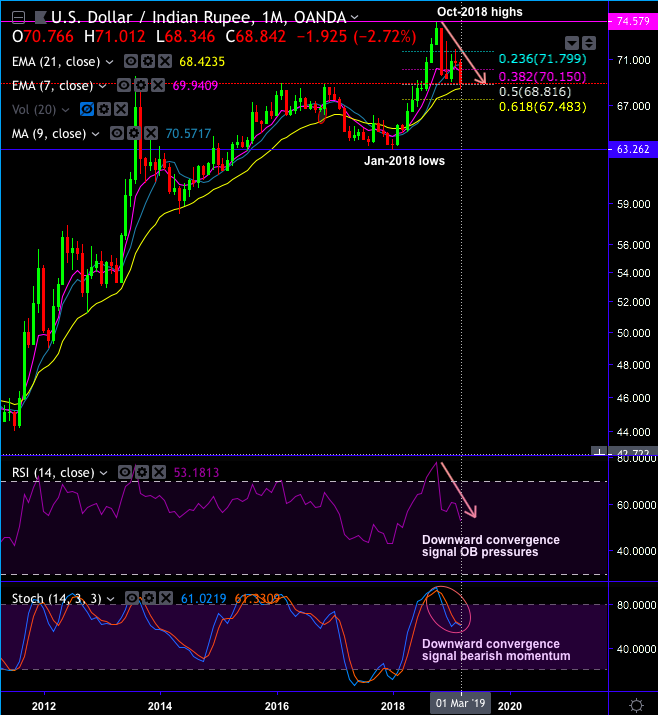
USDINR has again slid below 68.75 marks with intraday bias remains bearish for the moment. We prefer to take a short position on both technical and fundamental grounds.
Technically, the pair has formed the bearish engulfing pattern that plummets prices below 7-EMAs as momentum oscillators signal intensified bearish momentum (refer above chart).
The Reserve Bank of India’s upcoming USD5bn swap deal which is scheduled on March 26thneeds to be observed in a context that the deal should be perceived as a new instrument to infuse liquidity and not as a tool to influence the exchange rate. Theoretically, the RBI’s purchases of US dollars from banks in exchange for rupees should work against further appreciation via the fall in the implied yield for the longer-dated USDINR forwards.
It is reckoned that, in the short-term, the Indian rupee has become a barometer of the Indian union elections to be scheduled between April 11thand May 19th. This was best reflected by the surge in net foreign equity investment in February-March. The Sensex has rallied 8.5% since February 19 on polls that no longer point to a hung parliament but a victory for Prime Minister Modi and his coalition.
The rupee has also been helped by a favorable external environment. The Fed’s pause in hiking rates has renewed interest in carry trades in the South and Southeast Asian currencies. Global equity markets have recovered on US and China working towards a trade deal and the UK looking to avert a disorderly Brexit.
Unfortunately, none of these factors are firm. We are still looking for two Fed hikes in the second half of this year. As for the negotiations, there are no guarantees that intentions would lead to a US-China trade deal in 2Q’19 or that the UK avoids exiting the EU without a deal on March 29. Neither will there be a repeat of the landslide victory for Prime Minister Modi and the enthusiasm for reforms witnessed at the 2014 elections.
We remain mindful that Modi’s first term resulted in record lows for the rupee on twin fiscal and current account deficit and rising external debt. Our target remains for USDINR to end the year above 70. In short-term, profit-taking has started to set in after USDINR hit 68.9, the 50% retracement level of its 2018 rise (refer above chart).
Short positions in this pair have been advocated, we prefer to uphold those positions on USDINR at spot levels, stop loss at 69.13 for targets of 68.58 or even up to 68.34/67.88 levels. Courtesy DBS
Currency Strength Index: FxWirePro's hourly USD spot index is inching towards -26 levels (which is mildly bearish), while articulating (at 13:02 GMT).
For more details on the index, please refer below weblink: http://www.fxwirepro.com/currencyindex













