


 Philippines Current Account Deficit Seen at $19.1 Billion in 2026
  Energy Sector Outlook 2025: AI's Role and Market Dynamics
  Arthur Hayes Announces FLOP Testnet Launch Within Weeks
  Trump’s "Shock and Awe" Agenda: Executive Orders from Day One
  Fed Unveils Stablecoin Rules Under GENIUS Act
  ECB May Stop Rate Hikes After December, Capital Economics Says
  Fed’s Hammack Says Bond Yield Surge Is Not Driven by Inflation Fears
  Bitcoin Price Faces Volatility Ahead of US CPI and Fed Speech
  Visa Wins China Approval to Prepare Domestic Payments Expansion
  Indonesia Surprises Markets with Interest Rate Cut Amid Currency Pressure
  DeFi Development Adds 22,070 SOL to Solana Treasury
  Hong Kong’s Second Solana ETF Launches With Lower Fees
  UBS Predicts Potential Fed Rate Cut Amid Strong US Economic Data
  Gold Prices Fall Amid Rate Jitters; Copper Steady as China Stimulus Eyed
  US Futures Rise as Investors Eye Earnings, Inflation Data, and Wildfire Impacts
  Zcash Price Analysis: Can ZEC Rebound Above $1,300?


 Add as a preferred source on Google
It’s been central banks’ monetary policy season in G10 economies, SNB, BoE, FED, and BoJ are lined up for monetary policy meetings in this month, followed by RBA on October 1st week.
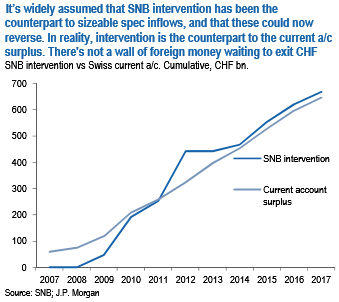
As a matter of balance of payments arithmetic, SNB intervention has been the counterpart to Switzerland’s current account surplus over the past decade, not speculative inflows.
Indeed, the SNB’s cumulative intervention since 2007 is almost exactly the same as the cumulative current account surplus over this period (around CHF 650bn – refer above chart).
The driving force for CHF appreciation over this period is therefore not speculative capital inflows, but rather a persistent dearth of capital outflows. That may seem like a semantic difference but is, in fact, crucial to how we assess the franc’s prospects. If our analysis is correct, there simply is no wall of safe-haven money that should flood out of CHF, irrespective of how bright the euro’s prospects.
On the flip side, AUD likely to gain more traction given the RBA adopts a more hawkish tone to its communications during its cash rate announcement that's scheduled on October 3rd.
Our RBA outlook (on hold for some time) is anchoring short-maturity interest rates, if the Aussie central bank maintains firmly on hold stance in its next monetary policy, as we expect, the counterpart currency would likely gain upper hand, which in turn lead the underlying pair (AUDCHF) non-directional trend that has prolonged in long run.
For more reading on our technicals analysis, refer below weblink:
But what is more significant for AUD is that Chinese data has been volatile in recent months, but Aussie dollar appears to be largely fair given the twists and turns in Chinese financial conditions of late.
AUD has traced China’s on-again off-again policy shifts on financial conditions and liquidity reasonably well over the past 9 years (refer above chart).
These mini-turns in financial conditions have not been easy to predict ahead of time, the cycle length is shortening, and the transmission to commodities looks more speculative than fundamental.
Still, these cycles have been influential for AUD, and suggest that any further developments by Chinese authorities on this front will bear watching in coming months.
Options strategy:
We recommend positioning longs in AUDCHF via optionality ahead of above-stated data events.
Long ADUCHF portfolios that make us shorting CHF vols all the more appealing. Instead of naked vanilla call form, we suggest call spread structure for the 1M horizon, optimizing strikes for leverage.
The strategy reads this way, longs in 1m ATM +0.51 delta call, simultaneously, short 2w (1%) OTM call at net debit.
Courtesy: JP Morgan







