


 Bank of America Predicts Yen Rebound as USD/JPY Faces Risks
  Cardano Hits Five-Year Transaction Record as ADA Price Falls
  Fed’s Hammack Says More Data Needed Before Next Rate Move
  RBI Rate Hike Bets Surge as Inflation Rises
  Trump Demands Powell Resign Over Fed Renovation Cost Overruns
  Most Americans Oppose Election Betting on Prediction Markets, Poll Finds
  Fed Minutes Signal Another Rate Hike by Year-End
  RBA Hikes Interest Rate to 4.60% as Inflation Risks Rise
  Bitcoin ETFs Lose $681 Million, Ending Three-Week Inflow Streak
  RBA Says ASX Still Falls Short on Governance and Risk Controls
  DeFi Development Adds 22,070 SOL to Solana Treasury
  Morgan Stanley Predicts $10 Trillion RWA Market by 2030
  BNB Price Faces Pressure as DOJ Investigates Binance


 Add as a preferred source on Google
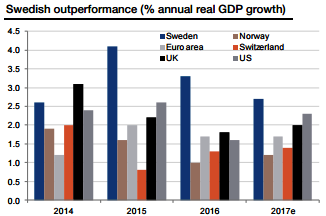
The April inflation data release out of Sweden reinforced our bullish medium-term view of the Swedish krona. With the Frexit risk evaporating with Macron's victory in the French presidential election, the market focus is increasingly turning to the potential for monetary policy shifts in Western Europe, particularly towards tightening.
The Swedish economy has been performing well for some time now, but the Riksbank has kept its dovish policy bias, given its lack of confidence about the durability of the reflation trend in the country (refer above chart).
This caution was not unwarranted, as we have seen how stronger growth has not translated into much higher inflation pressures outside Sweden. Moreover, the Riksbank has its own bitter experience from 2011-12, when headline CPI toppled from 3% to under 0% in a span of 15 months.
Growth and inflation data remain at odds in Sweden. Growth has been running at 4% annualized pace for the last two-quarters and the manufacturing PMI is the highest globally at a heady 65.2 (services at 61.3), yet the primary preoccupation of the Riksbank — inflation — has disappointed yet again.
In addition, an outcome for the French elections in line with our base case could result in modest EUR strength. To cushion against these moves we recommend raising the stop-out level on EURSEK by 0.55. Short NZDSEK through a put has underperformed substantially.
With a month left to expiry, we look for opportunities to unwind this trade.
Sold EURSEK at 9.4847 on January 13. Marked at -1.68%.
Long a NZD put/SEK call, strike 6.10, expiry May 23. Paid 1.47%, marked at 0.22%.







