


 2025 Market Outlook: Key January Events to Watch
  UBS Projects Mixed Market Outlook for 2025 Amid Trump Policy Uncertainty
  Stock Futures Dip as Investors Await Key Payrolls Data
  S&P 500 Relies on Tech for Growth in Q4 2024, Says Barclays
  Geopolitical Shocks That Could Reshape Financial Markets in 2025
  U.S. Banks Report Strong Q4 Profits Amid Investment Banking Surge
  Moldova Criticizes Russia Amid Transdniestria Energy Crisis
  Oil Prices Dip Slightly Amid Focus on Russian Sanctions and U.S. Inflation Data
  China’s Growth Faces Structural Challenges Amid Doubts Over Data
  US Futures Rise as Investors Eye Earnings, Inflation Data, and Wildfire Impacts
  Wall Street Analysts Weigh in on Latest NFP Data
  Fed May Resume Rate Hikes: BofA Analysts Outline Key Scenarios
  Gold Prices Fall Amid Rate Jitters; Copper Steady as China Stimulus Eyed
  Lithium Market Poised for Recovery Amid Supply Cuts and Rising Demand
  Mexico's Undervalued Equity Market Offers Long-Term Investment Potential
  Indonesia Surprises Markets with Interest Rate Cut Amid Currency Pressure
  Urban studies: Doing research when every city is different


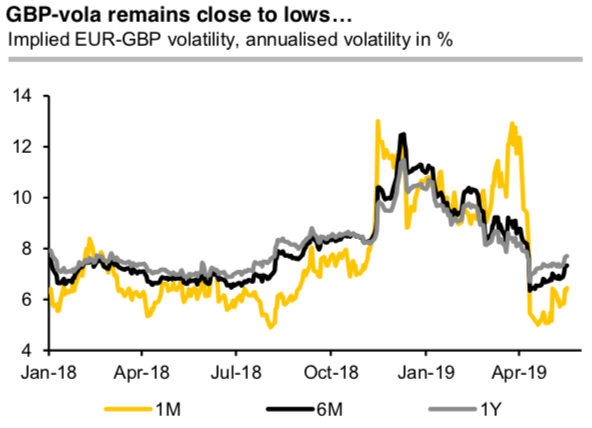
The Brexit apprehensions are gathering momentum again. The government announced the fourth vote on the exit agreement with the EU for 3rd June. This time around the vote is going to be directly on the legislation. In case of a defeat, it is likely to become almost impossible for Prime Minister Theresa May to present the issue to Parliament again.
Sterling continued to slip yesterday as this week’s sell-off took the pound to its lowest level against the US dollar since January. The pound has also fallen against the euro although the latter is down against the US dollar.
A statement from Graham Brady, the head of the UK Conservative backbench 1922 Committee, stated that he will meet with PM May to set a date for her to resign as party leader following a Parliamentary vote on the EU Withdrawal Bill in the first week of June. Meanwhile, reports suggest that the cross-party Brexit talks between the Tories and Labour are set to end today without a deal being struck.
Under such circumstances, we reckon that it is completely incomprehensible why implied volatility both for the next month (until about a week after the vote) and longer term until after the Brexit date at the end of October remain close to last year’s low. It has always been interpreted the combination of low implied volatility (refer 1st & 4th chart) and nonetheless raised (long term) EURGBP risk reversals (refer 2nd & 3rd chart) that we had seen since Brexit was postponed as meaning that the market expects a long period without progress – hence the low vol – but doesn’t expect a deal as a deal would be GBP positive and would, therefore, point towards lower risk reversals; i.e. the market seems to expect a probably continued Brexit delay.
However, that seems increasingly unrealistic. After the vote the situation is wide open again: either May manages to secure an orderly Brexit which would reduce GBP downside risks considerably, or a new Prime Minister brings new uncertainty and probably a tougher Brexit stance. Hence, we could foresee short term potential for a correction on the options market and space for further GBP depreciation. Courtesy: Sentrix, Saxo & Commerzbank
Currency Strength Index: FxWirePro's hourly GBP spot index is inching towards -74 levels (which is bearish), while EUR is at -5 (neutral), while hourly USD spot index was at 90 (bullish) while articulating (at 12:19 GMT).
For more details on the index, please refer below weblink: http://www.fxwirepro.com/currencyindex







