


 NASA's Artemis II Crew Arrives in Florida for Historic Moon Mission
  Eli Lilly’s Inluriyo Gains FDA Approval for Advanced Breast Cancer Treatment
  FDA Pilot Program Eases Rules for Nicotine Pouch Makers
  Trump and Merck KGaA Partner to Slash IVF Drug Costs and Expand Fertility Coverage
  Neuralink Expands Brain Implant Trials with 12 Global Patients
  Blue Origin New Glenn Explosion Could Delay Launch Operations Until 2028
  NASA Artemis II: First Crewed Moon Mission Since Apollo Takes Four Astronauts on 10-Day Lunar Journey
  Trump Administration to Launch Autism Initiatives Targeting Acetaminophen Use and New Treatment Options
  Trump Administration Releases New UFO Files and Apollo Mission Records


 Add as a preferred source on Google
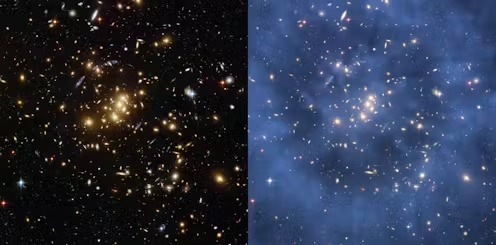

A ghost is haunting our universe. This has been known in astronomy and cosmology for decades. Observations suggest that about 85% of all the matter in the universe is mysterious and invisible. These two qualities are reflected in its name: dark matter.
Several experiments have aimed to unveil what it’s made of, but despite decades of searching, scientists have come up short. Now our new experiment, under construction at Yale University in the US, is offering a new tactic.
Dark matter has been around the universe since the beginning of time, pulling stars and galaxies together. Invisible and subtle, it doesn’t seem to interact with light or any other kind of matter. In fact, it has to be something completely new.
The standard model of particle physics is incomplete, and this is a problem. We have to look for new fundamental particles. Surprisingly, the same flaws of the standard model give precious hints on where they may hide.
The trouble with the neutron
Let’s take the neutron, for instance. It makes up the atomic nucleus along with the proton. Despite being neutral overall, the theory states that it it made up of three charged constituent particles called quarks. Because of this, we would expect some parts of the neutron to be charged positively and others negatively –this would mean it was having what physicist call an electric dipole moment.
Yet, many attempts to measure it have come with the same outcome: it is too small to be detected. Another ghost. And we are not talking about instrumental inadequacies, but a parameter that has to be smaller than one part in ten billion. It is so tiny that people wonder if it could be zero altogether.
In physics, however, the mathematical zero is always a strong statement. In the late 70s, particle physicistsnRoberto Peccei and Helen Quinn (and later, Frank Wilczek and Steven Weinberg) tried to accommodate theory and evidence.
They suggested that, maybe, the parameter is not zero. Rather it is a dynamical quantity that slowly lost its charge, evolving to zero, after the Big Bang. Theoretical calculations show that, if such an event happened, it must have left behind a multitude of light, sneaky particles.
These were dubbed “axions” after a detergent brand because they could “clear up” the neutron problem. And even more. If axions were created in the early universe, they have been hanging around since then. Most importantly, their properties check all the boxes expected for dark matter. For these reasons, axions have become one of the favourite candidate particles for dark matter.
Axions would only interact with other particles weakly. However, this means they would still interact a bit. The invisible axions could even transform into ordinary particles, including – ironically – photons, the very essence of light. This may happen in particular circumstances, like in the presence of a magnetic field. This is a godsend for experimental physicists.
Experimental design
Many experiments are trying to evoke the axion-ghost in the controlled environment of a lab. Some aim to convert light into axions, for instance, and then axions back into light on the other side of a wall.
At present, the most sensitive approach targets the halo of dark matter permeating the galaxy (and consequently, Earth) with a device called a haloscope. It is a conductive cavity immersed in a strong magnetic field; the former captures the dark matter surrounding us (assuming it is axions), while the latter induces the conversion into light. The result is an electromagnetic signal appearing inside the cavity, oscillating with a characteristic frequency depending on the axion mass.
The system works like a receiving radio. It needs to be properly adjusted to intercept the frequency we are interested in. Practically, the dimensions of the cavity are changed to accommodate different characteristic frequencies. If the frequencies of the axion and the cavity do not match, it is just like tuning a radio on the wrong channel.

The powerful magnet is moved to the lab at Yale. Yale University, CC BY-SA
Unfortunately, the channel we are looking for cannot be predicted in advance. We have no choice but to scan all the potential frequencies. It is like picking a radio station in a sea of white noise – a needle in a haystack – with an old radio that needs to be bigger or smaller every time we turn the frequency knob.
Yet, those are not the only challenges. Cosmology points to tens of gigahertz as the latest, promising frontier for axion search. As higher frequencies require smaller cavities, exploring that region would require cavities too small to capture a meaningful amount of signal.
New experiments are trying to find alternative paths. Our Axion Longitudinal Plasma Haloscope (Alpha) experiment uses a new concept of cavity based on metamaterials.
Metamaterials are composite materials with global properties that differ from their constituents – they are more than the sum of their parts. A cavity filled with conductive rods gets a characteristic frequency as if it were one million times smaller, while barely changing its volume. That is exactly what we need. Plus, the rods provide a built-in, easy-adjustable tuning system.
We are currently building the setup, which will be ready to take data in a few years. The technology is promising. Its development is the result of the collaboration among solid-state physicists, electrical engineers, particle physicists and even mathematicians.
Despite being so elusive, axions are fuelling progress that no ghost will ever take away.







