


 Japan Signals Readiness to Act on Yen as Intervention Speculation Grows
  U.S. Dollar Drops as Weak Jobs Data Boosts Fed Pause Bets, Yen Jumps on Intervention Talk
  State of emergency in Crimea as Ukraine focuses pressure on ‘jewel in Putin’s crown’
  New Zealand Consumer Confidence Rises in June as Inflation Expectations Ease
  Mary Daly Says AI Uncertainty Clouds Fed Rate Outlook Despite Restrictive Policy
  Elon Musk is remaking the world, like Henry Ford before him – but more dangerously
  Goldman Sachs Says China Competition Weighs More on EU Growth Than Trade Deficit
  Oil Prices Steady as U.S.-Iran Peace Talks Ease Strait of Hormuz Supply Fears
  Japan Signals Surprise Yen Intervention Strategy as BOJ Hawkish Stance Puts FX Traders on Alert
  Australia Trade Balance Swings to Surprise Deficit as Imports Outpace Exports in May
  USA at 250: the Black American struggle for life, liberty and the pursuit of happiness
  Oil Prices Steady as U.S.-Iran Talks Ease Supply Fears Ahead of Holiday Weekend
  Buy the Dip: Gold Holds Strong at $3980, Targets $4150
  Brazil to Phase Out Gasoline Subsidy First as Diesel Support Stays Longer
  US Jobs Report Preview: June Payroll Growth Seen Slowing as Fed Rate Decision Looms


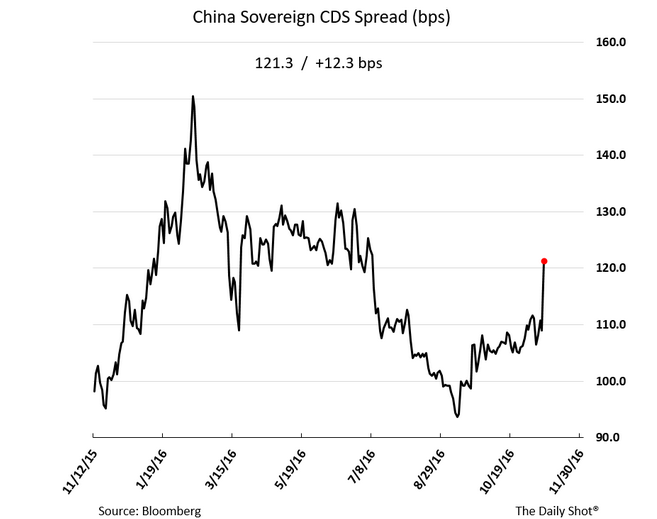
China started trading of credit-default swaps (CDS) on the nation’s interbank market after being faced with rising bond failures. In September 2016 the People’s Bank of China (PBoC) approved CDS trading by financial institutions on the interbank market and ten Chinese financial institutions, mostly banks, conducted the first batch of credit default swap (CDS) transactions on November 1st.
China’s rapidly rising corporate debt on the back of uncontrolled credit-fuelled stimulus poses a major risk to the country’s longer-term outlook. China’s corporate debt which currently stands at 169 percent of GDP triggers concerns regarding corporations’ future debt servicing ability and banking sector soundness. China's Dongbei Special Steel went bankrupt last month after failing to repay its debts of several billion yuan nine times.
Sentiment toward China will remain volatile over the coming months, impacted by corporate debt overhang, developments in the housing market, concerns regarding economic growth and industrial over-capacity, structural reform progress, and authorities’ intervention. The demand for CDS is increasing as risks of defaults grow.
In March 2016, Standard and Poor’s and Moody’s rated China at “AA-” and “Aa3”, respectively with a “negative” outlook on the back of rather slow progress on the economy’s rebalancing. Fitch rates China in the “A+” category with a “stable” outlook.
In Monday's trading, ten institutions including China’s four biggest banks conducted 15 CDS deals with a combined 300 million yuan ($44 million) of notional principal, according to the National Association of Financial Market Institutional Investors (NAFMII) statement. China’s 5-year credit default swap has jumped 15 basis points (bps) to 125 bps since the beginning of November.
USD/CNY was 0.5 percent higher on the day. At around 1130 GMT FxWirePro's Hourly US Dollar Spot Index was at 49.1506 (Bias Neutral). For more details on FxWirePro's Currency Strength Index visit http://www.fxwirepro.com/currencyindex .







