


 Oil Prices Drop as Strait of Hormuz Shipping Recovers
  Australian Household Spending Rebounds Strongly in May as Travel and Dining Drive Consumer Growth
  Best Gold Stocks to Buy Now: AABB, GOLD, GDX
  Asian Markets Rally as Micron and Qualcomm AI Outlook Lifts Global Tech Stocks
  Wall Street Slides as AI Stocks Tumble Following South Korea Tech Sell-Off
  White House Seeks $87.6 Billion Emergency Funding for Iran War, Farmers, and Ebola Response
  South Korea Remains MSCI Emerging Market Despite Reform Progress
  New Zealand Fast-Tracks Gold Mining as Industry Revival Gains Momentum
  Australia Jobs Growth Strengthens Rate Hike Outlook
  BOJ Hawk Signals Faster Interest Rate Hikes Amid Inflation Risks
  Australia Inflation Cools in May, But Core CPI Keeps RBA Rate Hike Risks Alive
  Wall Street Ends Mixed as Tech Stocks Struggle Ahead of Micron Earnings


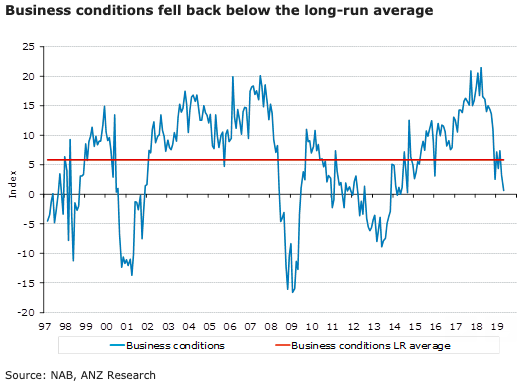
Australia’s business conditions for the month of May slumped to its weakest level since they briefly fell to almost zero in September 2014, although the confidence was up quite strongly during the period.
Business conditions fell to 0.6 in May. The sub-indices were mixed: profits, capacity use, and trading fell, while employment, exports, labour costs and purchases costs rose modestly. At 2, the employment index is consistent with modest jobs growth, while capacity use points to a sharply higher unemployment rate.
Conditions fell in New South Wales and Victoria to well below average levels, though the three-month moving averages are still around or close to average. Conditions also fell a touch in South Australia, though are still strong; and they remain above average in Tasmania – though well off recent highs. Conditions continued to deteriorate in Western Australia.
The change in conditions across industries was mixed. Mining fell, but remains elevated. Retail conditions deteriorated very sharply, to the weakest monthly level since March 2001. Transport was down by some margin, while the finance and recreational sectors fell a smaller amount. Manufacturing, construction and wholesale all rose somewhat.







