


 US Stock Futures Hold Steady as Soft Inflation Data Eases Fed Rate Hike Fears
  Gold Prices Slip as Oil Rally Fuels Inflation Fears, Strengthens Dollar
  IEA Warns China Rare Earth Export Curbs Could Threaten $6.5 Trillion in Global Production
  Wall Street Ends Lower as AI Selloff, Iran Tensions Weigh on Tech Stocks
  Asian Stocks Slide as Nikkei Leads Losses on Tech Selloff and Rising U.S.-Iran Tensions
  Brazil Weighs IP Curbs, Patent Suspensions After New U.S. Tariffs
  AI Chip Stocks Face Valuation Pressure as Investors Shift Toward Big Tech and Software
  UBS Boosts China Tech Bets, Adds Kuaishou and Meituan to Focus List
  Brent Oil Jumps 16% for Best Week Since April as US-Iran Conflict Fuels Supply Fears


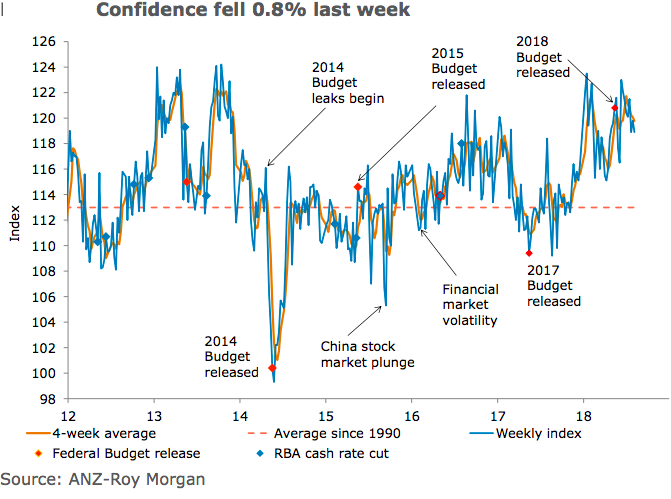
Australia’s ANZ-Roy Morgan weekly consumer confidence reversed previous week’s gains, with the latest reading down 0.8 percent and entirely reversing the prior week’s gain. The details were mixed, with gains in views towards current financial and future economic conditions partially offsetting falls in the remaining sub-indices, according to the latest report from ANZ Research.
Households’ optimism towards current financial conditions improved 0.5 percent last week, on the back of a 2.9 percent increase in the previous week. However, households were less optimistic about future financial conditions, which decreased 1.3 percent. Consumers’ assessment of current economic conditions declined 2.7 percent last week, partially unwinding the 4.1 percent gain in the previous week.
Meanwhile, views towards future economic conditions were up 1.4 percent last week following a 0.3 percent rise in the previous week. The ‘time to buy a household item’ sub-index fell 1.7 percent – its third consecutive weekly decline – to its lowest point in 16 weeks. Four week moving average inflation expectations edged back up to 4.3 percent.
"Given the fall in house prices, high levels of household debt and an already low savings rate future consumption growth is likely to depend heavily on wage growth. On this front, we look to the WPI print out on August 15, to provide some comfort that wages growth is past its bottom and will gradually move up," said David Plank, Head of Australian Economics, ANZ Research.







