


 Investors Brace for Market Moves as Trump Begins Second Term
  Asian Stocks Slide as Semiconductor Selloff Weighs on South Korea and Japan
  S&P 500 Surges Ahead of Trump Inauguration as Markets Rally
  Tech Stocks Rally in Asia-Pacific as Dollar Remains Resilient
  UK Markets Face Rising Volatility as Hedge Funds Target Pound and Gilts
  UK Services PMI Returns to Growth in July as New Orders and Confidence Rebound
  China’s Growth Faces Structural Challenges Amid Doubts Over Data
  Gold Prices Steady as Hormuz Tensions Fuel Fed Rate Concerns
  Apple Downgraded by Jefferies Amid Weak iPhone Sales and AI Concerns
  Oil Prices Set for Steep Weekly Losses as Hormuz Deal Stalls
  Wall Street Ends Mixed as Dow Hits Record Despite Tech Weakness
  China Exports Beat July Forecasts as AI Demand Fuels High-Tech Trade
  KiwiSaver shakeup: private asset investment has risks that could outweigh the rewards
  Trump Unveils $3 Billion U.S. Critical Minerals Push
  Insignia Financial Shares Hit 3-Year High Amid Bain and CC Capital Bidding War
  Canada, US Hold Constructive Trade Talks as Tariff Negotiations Continue




Private business investment is one of the key drivers of economic growth.
Business investment in equipment (and even in buildings) drives productivity, which the Nobel Prize winning economist Paul Krugman famously observed
isn’t everything, but in the long run it is almost everything
As he put it, a country’s ability to improve its standard of living over time “depends almost entirely on its ability to raise its output per worker”.
Which is why one of the forecasts in this month’s budget stood out.
The budget forecast non-mining business investment to grow 1.5% in the coming 2021-22 financial year, after falling last year and then to jump a huge 12.5% during 2022-23.
Thursday’s capital expenditure figures released by the Bureau of Statistics are important not only because they tell us what private firms have been spending on plant and equipment and buildings and structures, but also what they are planning to spend in the months and years ahead.
The survey that points to the future
Economists like me are pretty sceptical of surveys.
We like to see what people actually do (so-called “revealed preference”), rather than what they say they intend to do (“stated preference”).
But the bureau has a decent track record with this survey. In part that’s because the people surveyed are the chief financial officers of the major firms. They tend to report what they know is in train rather than “spin” grander visions.
And they usually understate what eventually happens.
On what has actually happened, their reports suggest that private non-mining business investment bounced back 7.1% in the first three months of this year.
In the six months to March (since September) it jumped 13.8%, after falling 11.4% in the previous six months of COVID restrictions leading up to September.
Quarterly non-mining private capital expenditure
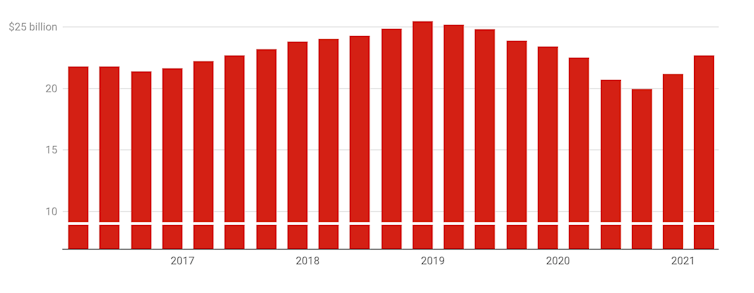
ABS Private New Capital Expenditure and Expected Expenditure, Australia
When it comes to what lies ahead, the estimates for 2021-22 are picking up.
The March estimate is up 11.3% from the estimate made in December.
It is still well down on the latest estimate for 2020-21, about 13% down. But actual non-mining investment is usually somewhere between 30% and 50% higher than what’s expected (the bureau calculates “realisation ratios”) meaning there’s a good chance it will meet the budget forecast for 2021-22.
Whether it will make it over the much larger bar of the 12.5% increase forecast for 2022-23 is an open question.
The point is, the figures published on Thursday give us no reason for thinking it couldn’t. The Bureau of Statistics has left open the possibility of very good news.
The bounce-back in investment exceeds market expectations.
Better, and better than expected
JP Morgan reports that the consensus of forecasts was for an overall increase in investment (mining and non-mining) of 2% in the March quarter. We got 6.3%.
It matters because it tells us businesses are feeling optimistic about the future — optimistic enough to expand, notwithstanding everpresent uncertainties.
We don’t know when our international borders will reopen. We don’t know how long Melbourne’s newest lockdown will last. We don’t know whether enough Australians will be vaccinated to reach herd immunity.
And the results also matter because more business investment will be needed if we are to drive unemployment down to the government’s new (and very welcome) target of somewhere below 5%.
The extra jobs will have to come from enterprises employing more people. They won’t do it unless they think it is worthwhile to invest.







