


 South Korea Exports Surge 83.5% on AI Chip Boom
  Bitcoin Exchange Reserves Hit Multi-Year Low at 2.68 Million BTC
  XRP Ledger Hits 10 Million AI Payments as Bitcoin Retreats
  BOJ Signals Faster Rate Hikes as Inflation Risks Grow
  RBA Set for September Rate Hike as Inflation Stays High
  G20 Divided Over US Push to Curb Industrial Overcapacity
  Tokyo Inflation Jumps to 2.7%, Boosting BOJ Rate Hike Expectations
  Fed Unveils Stablecoin Rules Under GENIUS Act
  Bitcoin Posts 42.7% Q3 Gain as ‘Uptober’ Begins Amid Crypto Turmoil
  Midnight NIGHT Token Surges 86% as Smart Contract Launch Nears
  RBA Hikes Interest Rate to 4.60% as Inflation Risks Rise
  BOJ Flags Import Costs and Yen Shocks as Persistent Inflation Risks
  Middle East Oil Exports Recover as Tanker Costs Surge


 Add as a preferred source on Google
The Bank Negara Malaysia (BNM) in its first monetary policy meeting of 2017 on 16th January held its benchmark overnight policy rate at 3.00 percent and said that the decision was supported by stronger household demand, higher inflation prospects and weak MYR. In the monetary policy statement that followed BNM noted that the private sector activity will be the key driver of economic growth and committed to continuously inject liquidity to ensure stable FX market.
Data released in February showed the pace of contraction in Malaysia’s manufacturing sector eased in January, indicating that the manufacturing sector had come through the worst of its downturn. Malaysia's headline Nikkei manufacturing PMI index rose to 48.6 in January from 47.1 in December. The pace of contraction in production also decelerated to the weakest since May 2015. Business confidence also rose to a four-month high at the beginning of 2017.
Meanwhile, employment in the sector stayed in the expansion territory for the fifth straight month. However, the pace of job creation slowed further and was just marginal. The weak ringgit aided in stimulating exports, but at the same time it continued to put upward pressures on cost burdens, with input prices rising at the most rapid rate in the series history. Prices charged rose at the sharpest pace since May 2016.
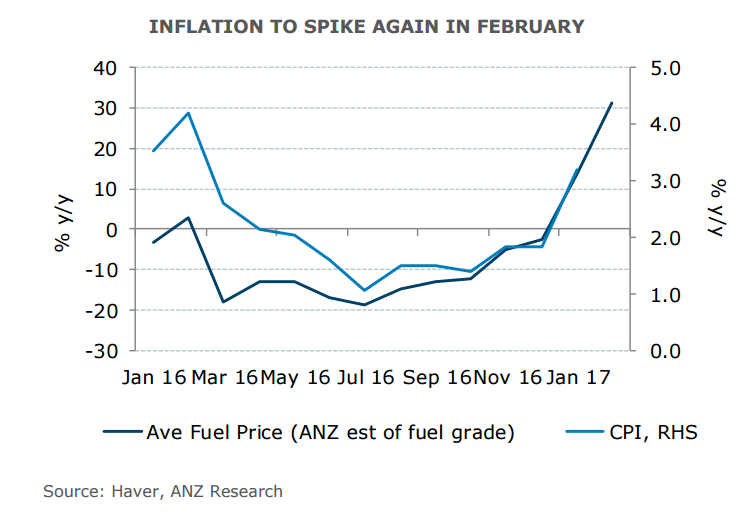
Malaysia’s headline CPI spiked in January owing to higher domestic fuel prices. Data released earlier on Wednesday showed Malaysia’s headline CPI spiked to 3.2 percent in January from 1.8 percent in December, much higher than consensus forecasts at 2.7 percent. Transport costs rose a significant 8.3 percent y/y in January while food price inflation (which has a 30.2 percent weight in the CPI basket) also increased 4.0 percent y/y during the month, partly due to removal of subsidies for essential items such as cooking oil. Going forward, Malaysia’s inflation is likely to continue to edge higher in February as oil prices continue their grind higher. Analysts at ANZ Research expect inflation in February to rise to 4 percent y/y.
Currency stability will be a key focus for the central bank in the near term. Downside risks to growth due to global uncertainties remain, but a recent upturn in some indicators including exports will allow the central bank to breathe more easily. Hence the inflation spike by itself is unlikely to elicit a policy response from BNM.
"We expect Bank Negara Malaysia (BNM) to maintain their benchmark overnight policy rate at 3.00% at their upcoming policy meeting on 2 March as economic activity has evolved in line with expectations," said ANZ Research in a report.
The Malaysian ringgit was extending range trade against the US Dollar at 4.4555 at 0930 GMT. FxWirePro's hourly USD strength index was slightly bullish at 53.1002. For more details on FxWirePro's Currency Strength Index, visit http://www.fxwirepro.com/currencyindex.







