


 US Comfortable With Canada Trade Standoff as Import Bans Loom
  FxWirePro: Daily Commodity Tracker - 21st March, 2022
  Gold Prices Fall as Treasury Yields Rise on Fed Rate Hike Bets
  Best Gold Stocks to Buy Now: AABB, GOLD, GDX
  Dollar Holds Near Two-Month High as Yen Approaches 160


 Add as a preferred source on Google
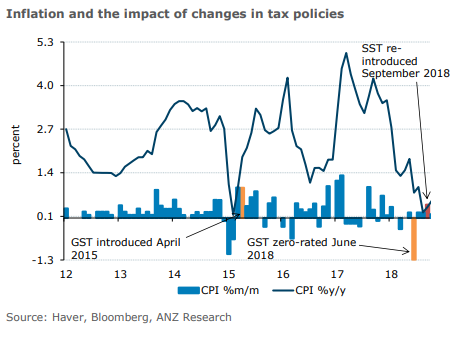
Malaysia’s underlying inflation is expected to remain low and stable through the first half of 2019. Combined with more moderate economic activity and external factors such as trade tensions, Bank Negara Malaysia (BNM) to keep the OPR unchanged at 3.25 percent for a while, according to the latest report from ANZ Research.
Headline CPI inflation crept up to 0.3 percent y/y in September from 0.2 percent y/y in August. On a sequential basis, headline inflation increased 0.4 percent m/m in September following a 0.2 percent m/m rise in August.
Although the Sales and Service Tax (SST) came into effect on September 1, its impact was muted presumably because leftover inventories and inputs were not subject to the price rise. The impact will likely be evident over the next few months as firms pass on the SST to consumers.
Government subsidies on RON95 grade fuel and diesel continue to shield Malaysian consumers from global oil prices and are largely responsible for the lower contribution of the transport component in recent months.
Meanwhile, on a sequential basis, food and beverage prices (which account for 29.5 percent of the basket) were up 0.5 percent m/m driven by an increase in fish and seafood prices, as well as the ‘food away from home’ subcomponent.







